
Roof Insurance Claims Explained: What Missouri Homeowners Should Know Before a Storm
Mid-Missouri storms—hail, wind, and tornadoes—regularly damage roofs across Columbia, Jefferson City, Lake of the Ozarks, and surrounding areas. The best way to protect your home and your insurance claim is preparation before severe weather arrives, not scrambling afterward.
Key Takeaways
- Most homeowners insurance policies cover sudden and accidental damage from hail, wind, and falling trees, but they do not cover neglect, normal wear and tear, or pre-existing leaks. Regular maintenance and documentation are essential to a successful roof insurance claim.
- Understanding your coverage type matters more than you might think. The difference between Actual Cash Value (ACV) and Replacement Cost Value (RCV) can mean thousands of dollars after a 2024–2025 storm. A 15-year-old roof on an ACV policy might only receive 40–60% of what full replacement would cost.
- Contact a trusted local roofer before calling your insurance company. Having a professional inspection from a reputable contractor like CoMo Premium Exteriors can identify hidden damage and prevent underpaid claims.
- This guide provides a clear, Missouri-specific step-by-step plan for what to do before, during, and after a storm—plus how our team can walk you through the entire insurance claim process from inspection to final repairs.
Understanding Roof Insurance Basics in Missouri
Spring and early summer bring the worst of Mid-Missouri’s storm seasons, with hail and tornado outbreaks peaking from April through June. Late-fall wind events add another layer of risk. From Columbia to Jefferson City and Lake of the Ozarks, roof claims are a common reality for homeowners in our region.
What a Standard HO-3 Policy Typically Covers
Most homeowners insurance policies in Missouri follow the HO-3 format, which covers roof damage from:
- Hail (the most common cause of claims in our area)
- Wind and tornado damage
- Lightning strikes
- Falling trees or limbs
- Fire
This coverage applies to sudden and accidental damage—meaning events that happen unexpectedly and quickly, not gradual deterioration.
What Is Typically Not Covered
Your home insurance will generally exclude:
- Age-related wear and tear
- Long-term leaks that developed over months or years
- Moss, rot, or mold from poor maintenance
- Animal damage (birds, squirrels, raccoons)
- Problems from skipped maintenance—for example, a small roof leak you ignored in 2020 that became a major issue by 2024
Dwelling Coverage and Underinsurance
Your dwelling coverage is the maximum amount your insurance provider will pay to repair or rebuild your home’s structure, including the roof. Many homeowners in Mid-Missouri carry coverage between $200,000 and $500,000, with the roof included in that total—not as a separate line item.
Here’s where underinsuring becomes a problem: if your coverage limits haven’t kept pace with rising material and labor costs (which have increased significantly since 2020), you could find yourself short after a major storm requires a full roof replacement.
Missouri-Specific Trends to Watch
Insurance policies in our state have shifted noticeably in recent years:
|
Trend |
What It Means for You |
|---|---|
|
Higher wind/hail deductibles |
Many policies now have percentage-based deductibles (1–2% of dwelling limit) instead of flat amounts |
|
Stricter roof age requirements |
Some carriers switch from RCV to ACV coverage once a roof reaches 10–15 years |
|
Faster reporting expectations |
While Missouri law allows up to a year in many cases, insurers increasingly expect claims within 30–60 days |
Check your declarations page before storm season to understand exactly what you’re working with.
How Missouri Weather Really Impacts Your Roof
Living in Mid-Missouri means preparing for a wide range of weather threats. April through June brings our most intense hail and tornado outbreaks. Straight-line winds can strike almost any time during storm season. Winter ice accumulation adds stress to aging shingles, and our notorious 40-degree temperature swings between seasons accelerate roof wear in ways that surprised even us when we first started installing roofs 25 years ago.
Recent Storm Examples
The spring 2023 hailstorms that hit Columbia and Jefferson City generated thousands of roof damage claims across Boone and Cole counties. The June 2024 wind event that swept through Boone and Callaway counties left many homeowners dealing with cracked shingles, damaged ridge caps, and dented gutters.
These aren’t isolated incidents—they’re the new normal for our region.
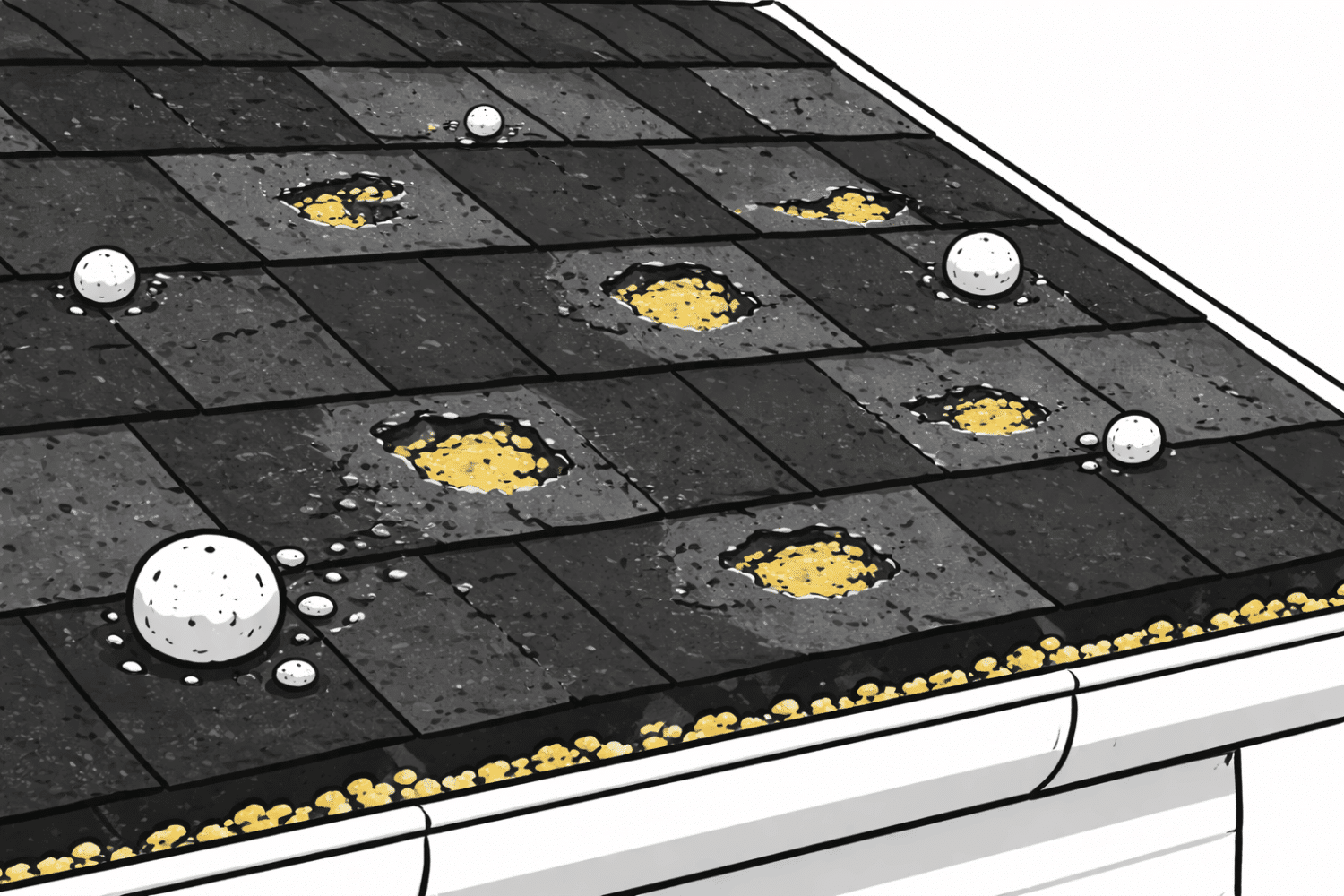
How Hail Actually Damages Your Roof
When 1-inch to 2-inch hail strikes asphalt shingles (the most common roof type in Missouri), it:
- Bruises and fractures the shingle material beneath the surface
- Loosens protective granules that shield against UV damage
- Creates weak spots that may not leak immediately but shorten roof life significantly
- Dents soft metals like vents, flashing, and gutters
The tricky part? Many homeowners can’t see hail damage from the ground. A professional ladder inspection is often the only way to confirm what happened.
Wind Damage Patterns
Strong winds during severe thunderstorms—50 to 70 mph gusts are common—can:
- Crease or lift shingles along ridges and edges
- Tear shingles completely away
- Break seals between shingle tabs
- Damage fascia, soffits, and gutters
Open rural areas and lakefront properties around Lake of the Ozarks often experience the most severe wind damage due to less natural windbreak protection.
The “Wear and Tear” Argument
Repeated temperature swings and heavy humidity in Mid-Missouri accelerate roof aging. This creates a challenge: when you file a roof claim, adjusters will scrutinize whether the damage is truly storm-related or the result of normal wear. Without clear documentation tying the damage to a specific storm date, it’s much easier for an insurance company to argue that your damaged roof simply aged out.

ACV vs. RCV: How Your Roof Is Actually Paid For
The type of roof coverage on your policy—Actual Cash Value versus Replacement Cost Value—is one of the single biggest factors determining how much money you’ll receive after a Missouri storm. This distinction can mean a difference of thousands of dollars, especially for older roofs.
Replacement Cost Value (RCV) Explained
With replacement cost value coverage, your insurance company pays what it costs in 2024–2025 dollars to replace your damaged roof with similar quality roofing materials, minus your deductible.
Here’s how RCV typically works:
- Initial payment: Insurance pays the actual cash value upfront (full cost minus depreciation minus deductible)
- Recoverable depreciation: After you complete repairs, you submit the final invoice and receive the withheld depreciation amount
This two-payment structure means you get the full cost of a new roof, but only after the work is done.
Actual Cash Value (ACV) Explained
With actual cash value coverage, insurance pays today’s depreciated value of your existing roof—essentially what your roof was worth at the moment the storm hit, not what it costs to replace.
Real-world example: A 15-year-old roof in Columbia damaged by April 2024 hail might have a replacement cost of $20,000. On an ACV policy, the homeowner might receive only $8,000–$12,000 (40–60% of replacement cost) because the roof had already used up most of its expected lifespan.
Roof-Surfacing Payment Schedules
Some Missouri insurers now use roof payment schedules that reduce payouts based on roof age:
|
Roof Age |
Typical RCV Payment |
Typical ACV Payment |
|---|---|---|
|
0–5 years |
100% minus deductible |
80–90% of replacement |
|
6–10 years |
100% minus deductible |
60–80% of replacement |
|
11–15 years |
May switch to ACV |
40–60% of replacement |
|
16–20 years |
Often ACV only |
20–40% of replacement |
Check your declarations page or call your insurance agent before storm season to understand exactly how your roof’s age affects your potential claim payout.
Planning Ahead
If you’re considering a roof replacement in 2024–2025 anyway, talk with us at CoMo Premium Exteriors and your insurance agent about upgrading to RCV coverage before the next major hail season. The premium difference is often modest compared to the protection it provides.
Steps to Take Before Storm Season Hits
February through April is the ideal time to prepare for Mid-Missouri’s severe weather season. Taking practical steps now prevents headaches later.
Schedule a Pre-Storm Inspection
We recommend scheduling a free pre-storm roof inspection with our team. This allows us to:
- Document your roof’s current condition with dated photos
- Identify and repair obvious issues before they become claim complications
- Create “before” documentation that proves the difference if a May or June storm causes damage
Review Your Policy Annually
Pull out your insurance policies each year and confirm:
- Your wind/hail deductible amount (is it a flat dollar amount or a percentage of dwelling coverage?)
- Whether you have ACV or RCV roof coverage (check for any age-based limitations)
- Whether your coverage limit is adequate for current 2024–2025 material and labor prices
If anything seems unclear, call your insurance agent directly. Getting answers now is far easier than during a post-storm claims rush.
Complete Basic Maintenance
Simple maintenance steps make it harder for insurers to blame damage on neglect:
- Clean gutters and downspouts
- Trim overhanging limbs that could fall on your roof
- Secure loose fascia or flashing
- Replace any missing or damaged shingles
- Address minor issues before they become major problems
These steps also demonstrate regular maintenance when your roof’s condition comes into question.
Create a Storm File
Prepare a “storm file”—either digital or physical—containing:
- Current insurance policy documents and declarations page
- Photos of your roof taken within the past year
- Contact information for CoMo Premium Exteriors: (573) 424-9008
- Receipts for any past roof work or repairs
- Your insurance agent’s direct phone number
Having everything in one place saves valuable time after a storm when you’re already dealing with stress.
What To Do Immediately After a Missouri Storm
When hail, high wind, or a tornado passes through Columbia, Moberly, Lake of the Ozarks, or anywhere else in Mid-Missouri, here’s what to do in the first 24–48 hours.
Safety First
Do not climb on a wet or visibly damaged roof. Instead:
- Walk around your property at ground level, looking up for obvious signs of damage
- Check attics and ceilings for signs of a roof leak or water stains
- Watch for downed power lines and report them immediately
- Note any damaged trees that may have struck your roof
Document Damage Thoroughly
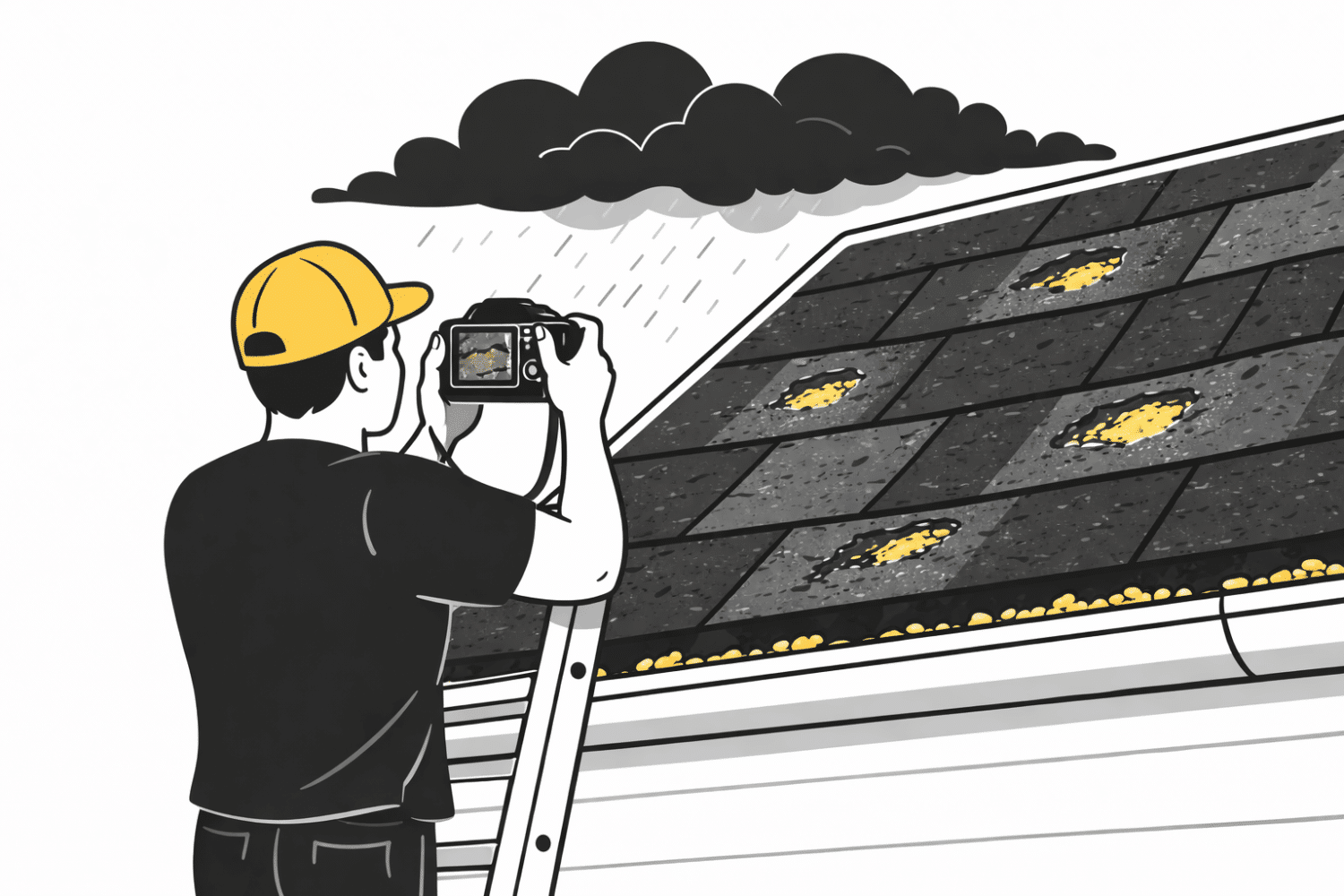
Take clear, date-stamped photos and videos from multiple angles:
- Visible signs of damaged shingles (missing, cracked, or torn)
- Dented gutters and downspouts
- Broken windows or damaged siding
- Any debris on or around your roof
- Interior water stains on ceilings or walls
- Wet insulation or drywall in the attic
The more evidence you have, the stronger your roof damage claim will be.
Call for a Professional Inspection
Before filing a claim, call CoMo Premium Exteriors at (573) 424-9008 for a prompt, free storm inspection. A trained local roofer can:
- Identify hidden hail or wind damage you can’t see from the ground
- Create a detailed inspection report with photos
- Provide a professional assessment of whether damage likely exceeds your deductible
Having this information before you contact your insurance company helps you speak confidently about what happened.
Handle Emergency Repairs Properly
For active leaks or missing sections of roof, temporary repairs are allowed—and often required by insurers to prevent further damage. This might include:
- Tarping exposed areas
- Placing buckets to catch leaks
- Covering broken windows
Important: Save all receipts for temporary repairs. These are typically reimbursable as part of your claim payout.
How the Roof Insurance Claim Process Works in Missouri
Understanding the typical timeline helps you navigate the claims process with confidence.
The Basic Timeline
- Storm event occurs
- Contractor inspection (ideally within 24–48 hours)
- Homeowner contacts insurer to file a roof claim
- Insurance adjusters visit to assess damage
- Claim decision issued with initial payment if approved
- Roof replacement or repair work completed
- Final payment released (recoverable depreciation for RCV policies)
Filing Deadlines
In Mid-Missouri, many carriers expect claims to be reported within 6–12 months of the date of loss. However, some policies have shorter internal deadlines, especially for wind and hail damage. We’ve seen companies push for reporting within 30–60 days, with “prompt notice of loss” clauses creating urgency.
Delaying beyond 60 days increases the risk of partial payouts or full rejection, as insurers may argue that damage worsened over time or cannot be definitively tied to the claimed storm.
When to File
File your claim only after you understand the extent of damage from a professional inspection. This allows you to:
- Speak confidently about what happened
- Reference specific damage areas
- Provide a realistic date of loss
On-Site Adjuster Meetings
Our team routinely meets adjusters on-site in Columbia, Jefferson City, Boonville, and surrounding towns. We point out damage in valleys, flashing, soft metal vents, and other areas that might be overlooked during a quick inspection. Statistics show claims with contractor accompaniment settle 30–50% higher because we catch secondary damage that adjusters often miss.
Keep a Claim Log
Document every conversation with your insurance company:
- Date and time of the call
- Name of the representative
- Summary of what was discussed
- Any claim numbers or reference numbers provided
This log prevents confusion and provides evidence if disputes arise later.
Documenting Roof Damage So Your Claim Sticks
Good documentation is often the difference between a fully approved successful roof insurance claim and a partial or denied one. Here’s what to capture.
Exterior Evidence Checklist
|
Evidence Type |
What to Photograph |
|---|---|
|
Wide shots |
Each roof slope from ground level |
|
Close-ups |
Hail hits on shingles showing bruising or granule loss |
|
Soft metals |
Dents on vents, gutters, downspouts, and flashing |
|
Shingle damage |
Lifted, torn, or missing shingles and ridge caps |
|
Impact points |
Debris damage, fallen limbs, or strike marks |
Interior Evidence
Don’t forget to document damage inside your home:
- Stained ceilings or walls
- Wet insulation in the attic
- Warped drywall or peeling paint
- Floor damage from water that entered through the roof
This interior evidence helps prove that roof damage allowed water infiltration—a key factor in many damage insurance claims.
Professional Inspection Reports
At CoMo Premium Exteriors, we provide written inspection reports that include:
- Dated photos of all damage areas
- Measured damage areas and affected sections
- Repair estimates or full replacement recommendations
- Assessment of whether damage meets insurance claim thresholds
You can submit these reports directly to your insurance carrier as supporting documentation.
Organize Everything
Create a date-labeled digital folder (for example, “May-26-2024 Hail Storm – Columbia”) containing all photos, videos, contractor reports, and communication logs. This organization makes it easy to share evidence with both the adjuster and any contractor working on your roof.
Working with Adjusters and Settlement Offers
Insurance adjusters work for the insurance company to confirm what happened, determine if it’s a covered peril, and estimate what repairs should cost. Understanding their role helps you navigate negotiations.
Have a Contractor Present
We strongly recommend having CoMo Premium Exteriors or another trusted roofing contractor present during the adjuster’s inspection. This ensures:
- All hail and wind damage is properly identified
- Less obvious damage areas (valleys, flashing, underlayment) aren’t missed
- Someone with roofing expertise can speak the same technical language as the adjuster
Understanding Initial Estimates
Adjusters typically write estimates using standardized pricing software like Xactimate. These estimates may not reflect:
- Specific Mid-Missouri labor costs
- Local code requirements (ice and water shield, drip edge, ventilation upgrades)
- Current material prices, which have fluctuated significantly
An initial estimate of $10,000 might actually require $18,000–$20,000 for a complete, code-compliant roof replacement.
Requesting Supplements
If the settlement offer feels low, you have options:
- Request a supplement by providing contractor repair estimates
- Submit additional photos documenting missed damage
- Include code documentation showing required upgrades
- Ask for a re-inspection with your contractor present
We frequently handle supplement discussions for clients, advocating for fair compensation based on accurate damage assessment.
Appeals and Disputes
Missouri homeowners generally have the right to appeal or reopen a claim within a certain period if:
- New damage is discovered after the initial inspection
- An estimate was clearly insufficient for proper repairs
- The adjuster missed significant damage areas
For complex disputes, you may consider consulting an insurance-focused attorney or a public adjuster (who typically charges 10–15% of the settlement).
Choosing the Right Roofing Contractor After a Storm
After major hail or tornado events, Mid-Missouri gets flooded with out-of-state “storm chaser” crews. These companies often appear with promises of quick repairs and cash deals, then disappear once the work is done—or when problems arise months later.
Warning Signs of Storm Chasers
- No local office or physical presence
- Pressure to sign contracts immediately
- Offers to waive your deductible (this is insurance fraud)
- No verifiable Missouri licensing or insurance
- Cannot provide local references
Statistics indicate that 40% of post-disaster roofs fail prematurely due to poor installation and claims handling by fly-by-night contractors.
What to Look for in a Reputable Contractor
|
Criteria |
Why It Matters |
|---|---|
|
Local presence |
Offices in or near Columbia, Jefferson City, or Lake of the Ozarks |
|
Established history |
In business since at least 2010 |
|
Proper licensing and insurance |
Protects you from liability |
|
Manufacturer certifications |
Proves ongoing training and quality standards |
|
Insurance claim experience |
Ability to write detailed scopes and handle supplements |
Our Triple Certification
CoMo Premium Exteriors is the only contractor in the region holding all three major manufacturer certifications:
- GAF Master Elite (top 3% nationwide, requiring annual factory training and 4.0+ customer ratings)
- Owens Corning Platinum Preferred
- James Hardie Elite Preferred
These certifications aren’t just logos—they represent consistent installation quality, ongoing education, and manufacturer-backed warranties that protect your investment.
Questions to Ask Any Contractor
Before signing, verify:
- Do you have experience working with insurance claims?
- Can you write a detailed estimate for the insurance company?
- Will you meet adjusters on-site?
- Do you handle supplements for code-required upgrades?
- What warranties do you offer (both manufacturer and workmanship)?
Insist on written contracts that clearly state roofing materials, ventilation upgrades, warranty details (including limited lifetime workmanship warranty), and start/completion dates.
Common Reasons Missouri Roof Claims Get Denied or Underpaid
Many denied claims or low settlement offers aren’t about storm severity—they’re about documentation, timing, or policy limitations.
“Wear and Tear” or “Pre-Existing Damage”
Insurers frequently cite these exclusions when:
- Roofs are older (15–20+ years)
- Homeowners cannot provide good documentation of when damage occurred
- Previous maintenance issues are visible
- No dated “before” photos exist
The older your roof, the more aggressively adjusters may argue that damage stems from poor maintenance rather than a sudden storm event.
Late Reporting
Claims filed long after a major storm face significant challenges:
- Reporting 2022 hail damage for the first time in 2024 is extremely difficult to prove
- Weather data becomes harder to correlate with specific damage
- Insurers question why you waited if damage was significant
File promptly—ideally within days or weeks, not months.
Missing Documentation
Without proper evidence, adjusters can easily conclude that damage is minor or unrelated to the claimed storm:
- No photos of damaged shingles before the entire roof was tarped
- No contractor inspection reports
- No receipts for temporary repairs
- No interior documentation of water stains or leaks
What to Do About Denied Claims
If you receive a denial or very low offer:
- Request the written denial reasons from your insurance provider
- Contact CoMo Premium Exteriors for a second-opinion inspection
- Submit supplemental evidence with additional photos and contractor reports
- Request a re-inspection with your contractor present
- Consider escalating to the Missouri Department of Commerce and Insurance
- Consult an insurance-focused attorney if you believe the decision is unfair
We’ve seen cases where initial $8,000 ACV denials were overturned to $25,000 RCV approvals through proper documentation and persistence.
Financing, Out-of-Pocket Costs, and Long-Term Value
Even with a solid insurance payout, you’ll typically be responsible for your deductible and any upgrades beyond what your insurance coverage pays for.
Understanding Your Deductible
Typical Mid-Missouri deductible ranges:
|
Deductible Type |
Common Amount |
|---|---|
|
Fixed dollar |
$1,000–$2,500 |
|
Percentage-based |
1–2% of dwelling coverage limit |
|
Separate wind/hail |
Often higher than standard deductible |
A $300,000 home with a 2% wind/hail deductible means $6,000 out of pocket before insurance pays anything—significantly more than a flat $1,000 deductible.
Upgrades Beyond Insurance Coverage
Upgrading to impact-resistant shingles, improved ventilation, or premium underlayment may add costs beyond what the insurance company owes. However, these upgrades can:
- Extend your new roof’s lifespan by 5–10 years
- Reduce future storm damage
- Lower insurance premiums (some carriers offer discounts for impact-resistant roofing materials)
Financing Options
CoMo Premium Exteriors offers financing options to help cover:
- Deductibles
- Non-covered upgrades
- Full replacements when damage doesn’t meet your deductible but your roof is near end-of-life
We believe costly repairs shouldn’t derail your household budget.
Think Long-Term
If you plan to stay in your home, consider the 20–30 year value of your roofing decision. A premium 30-year system using GAF Timberline HDZ or similar high-quality materials—backed by manufacturer warranties and our limited lifetime workmanship warranty—provides better long-term protection than a quick 15-year patch.
How CoMo Premium Exteriors Helps You Navigate Roof Insurance Claims
We’ve helped hundreds of Mid-Missouri homeowners navigate hail and wind claims since we opened our doors in 2010. After 25+ years of installing over 500 roofs and working with every major insurance carrier, we’ve learned what it takes to get homeowners fair treatment.
Our Support Process
- Free post-storm inspection: We assess your roof within 24–48 hours of your call
- Photo and video documentation: Comprehensive evidence for your claim file
- Detailed written report and estimate: Professional documentation using industry-standard Xactimate software
- Honest assessment: Guidance on whether filing a claim makes sense based on damage and your deductible
Adjuster Meetings
Our team meets on-site with adjusters from most major insurance carriers—State Farm, Shelter, American Family, and others. We speak their language, understand their estimating software, and advocate to ensure all legitimate storm damage is included in the scope of work.
Complete Roof System Replacements
When a roof replacement is needed, we handle the entire roof system:
- Premium asphalt shingles (GAF Timberline HDZ or similar)
- High-quality underlayment
- Proper flashing installation
- Ventilation upgrades as needed
- Gutters if damaged
All work is backed by our limited lifetime workmanship warranty—because we’ll be here in 10 years if you need us.
Get Started
Whether you’re preparing for storm season or recovering from recent damage, our team is here to help. Many homeowners have already called us this year for a free, no-obligation storm damage inspection and insurance claim review.
If you’re in Columbia, Jefferson City, Boonville, Moberly, Lake of the Ozarks, or anywhere in Mid-Missouri, give us a call at (573) 424-9008. We’ll walk you through your options—no pressure, just honest advice from people who’ve done this a thousand times.
FAQs
How long do I have to file a roof claim after a storm in Missouri?
Missouri law and individual insurance policies differ, but many insurers expect wind and hail claims to be filed within 6–12 months of the date of loss. Some policies set shorter internal deadlines—we’ve seen requirements for reporting within 30–60 days.
Check your policy’s “Duties After Loss” section and contact your agent as soon as possible after any major storm you believe caused damage. Ideally, report within days or weeks rather than months.
CoMo Premium Exteriors can help identify realistic storm dates using local weather data and hail maps to support timely claims when you’re unsure exactly when damage occurred.
Will filing a storm damage claim always raise my insurance rates?
Rate changes are influenced by many factors beyond your individual claim, including statewide and regional storm activity. After major weather events that affect thousands of homes, area-wide premium adjustments often occur whether or not you personally file a claim.
We suggest weighing the cost of repairs versus your deductible carefully. However, don’t avoid legitimate claims out of fear—especially when damage is significant and well-documented. The purpose of insurance is to protect you from exactly these situations.
What if my roof is older—will insurance still pay to replace it after hail?
Coverage for older roofs depends entirely on your policy. Some pay full replacement cost (RCV) up to a certain roof’s age, while others switch to actual cash coverage or roof payment schedules after 10–15 years.
Insurers may argue “wear and tear” more aggressively with older roofs, making proper documentation and a professional inspection even more critical. A detailed report from CoMo Premium Exteriors helps establish that damage resulted from a specific storm event, not gradual aging.
If you have a 15–20+ year-old roof, review your policy now. Discuss options to improve coverage before the next storm season if your current policy has significant age-based limitations.
Can I pick my own roofer, or do I have to use one recommended by my insurance company?
In Missouri, homeowners generally have the right to choose their own licensed roofing contractor. You are not required to use your insurance company’s preferred vendor or any contractor they suggest.
Choosing a trusted local roofer like CoMo Premium Exteriors gives you direct accountability. We’re focused on quality workmanship and your long-term satisfaction—not just meeting a low target price to satisfy an insurance network.
Get all contractor agreements in writing and confirm that the scope of work meets or exceeds what the insurance estimate covers.
What if I’m not sure whether the storm damage is bad enough to file a claim?
Schedule a free inspection with CoMo Premium Exteriors. We’ll assess the severity of hail or wind damage and give you an honest opinion on whether it’s likely to exceed your deductible.
Small, isolated damage—a few cracked shingles here and there—may be more cost-effective to handle out-of-pocket. But widespread bruising, multiple estimates of damage across the entire roof, missing shingles, or active leaks are strong indicators that a claim is warranted.
Having clear information before calling your insurance company helps you make confident, informed decisions about whether to file a roof insurance claim or handle repairs independently.
