
Black Roof Shingles vs Grey: Does Color Matter in Missouri?
Key Takeaways:
- Grey shingles reflect roughly twice as much solar energy as black — about 20% versus 10% — which means a cooler attic and lower cooling bills in Missouri summers.
- Black shingles run 50-70 degrees hotter than the air temperature on summer afternoons. Grey shingles run 30-50 degrees hotter. That difference affects both energy costs and shingle lifespan.
- The energy cost difference is real but modest — roughly $50-$150 per year for a typical Mid-Missouri home, depending on insulation levels and HVAC efficiency.
- Both colors are equally popular for resale. Charcoal and Weathered Wood (grey family) are the two most popular shingle colors nationally.
- Grey shingles may last slightly longer because lower surface temperatures reduce the thermal cycling that breaks down asphalt over time.
It’s Not Just About Looks
Choosing between black and grey shingles for your Columbia or Jefferson City home feels like a purely aesthetic decision. And curb appeal matters — you’ll live with this color for 20-30 years, and it’s one of the most visible features of your exterior.
But shingle color also affects your roof’s temperature, your attic’s heat load, your cooling bills, and potentially how long the shingles themselves last. In Missouri’s climate — where summer roof surfaces can hit 160 degrees and winter lows drop well below zero — the color you choose has measurable consequences beyond aesthetics.
Neither color is wrong. But understanding the tradeoffs helps you make a choice you’ll be happy with for decades, not just at the paint-chip stage.
How Shingle Color Affects Roof Temperature
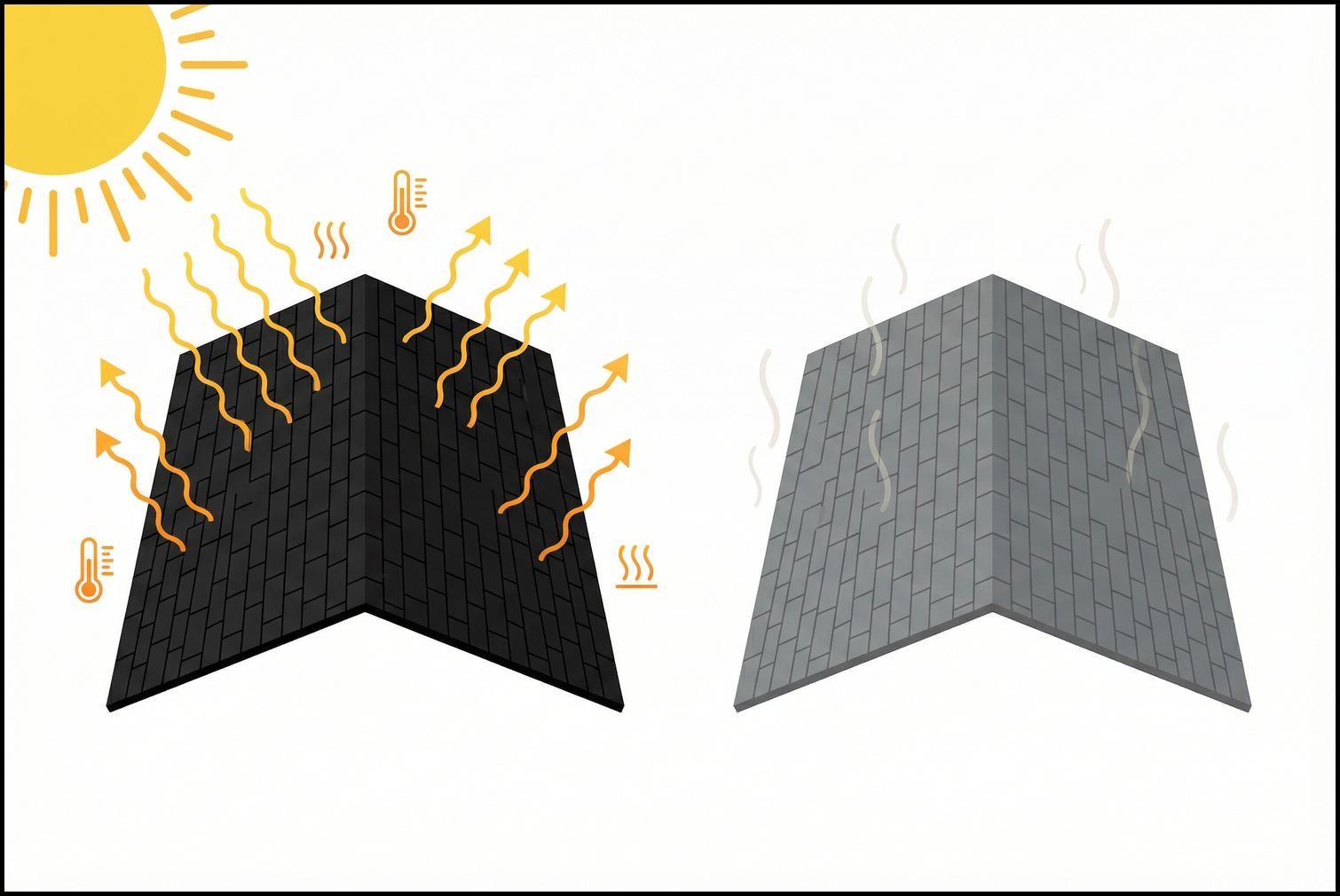
Research from Lawrence Berkeley National Laboratory quantifies the relationship between roof color and surface temperature. On a sunny summer day:
- Black shingles reflect about 10% of incoming sunlight and absorb the rest. Roof surface temperatures run 50-70 degrees above ambient air temperature. On a 95-degree August afternoon in Columbia, that means your black roof is hitting 145-165 degrees.
- Grey shingles reflect about 20% of sunlight — double what black reflects. Surface temperatures run 30-50 degrees above ambient, putting a grey roof at 125-145 degrees on that same afternoon.
That 20-degree surface temperature difference doesn’t sound dramatic, but it compounds in two important ways. First, less heat transfers through your roof deck into your attic, which means your HVAC system works less hard to keep your living space cool. Second, lower temperatures mean less thermal stress on the shingle material itself — less expansion and contraction cycling that gradually breaks down the asphalt binder.
Energy Cost Impact in Missouri
Missouri sits in IECC Climate Zone 4A — a “mixed-humid” zone with roughly equal heating and cooling demands. That means shingle color affects both seasons, but in opposite directions.
Summer advantage: grey. Field studies from the Florida Solar Energy Center measured average air conditioning savings of 19% when dark roofs were given reflective coatings — with savings ranging from 2% to 43% depending on insulation levels and attic ductwork. Missouri summers aren’t as intense as Florida’s, but the principle holds: more reflective shingles mean less cooling load.
Winter consideration: black. Black shingles absorb more solar heat in winter, which marginally reduces heating demand. However, LBNL research confirms that across most of the U.S. — including Missouri — summer cooling savings from lighter-colored roofs outweigh winter heating penalties. The net annual effect favors grey, though the difference is modest.
For a typical 1,500-2,000 square foot Mid-Missouri home with adequate attic insulation, the annual energy cost difference between black and grey shingles is roughly $50-$150. Over a 25-year roof life, that’s $1,250-$3,750 — not enough to change your color decision alone, but worth knowing when the aesthetic choice is a coin flip.
Does Color Affect How Long Shingles Last?
Yes, modestly. Asphalt shingles age through thermal cycling — the repeated expansion and contraction as the roof heats up during the day and cools at night. More extreme temperature swings mean faster aging.
Black shingles experience a wider daily temperature range than grey. On a summer day, a black roof might swing from 165 degrees at 2 PM to 75 degrees by midnight — a 90-degree cycle. A grey roof on the same day might swing from 145 to 75 degrees — a 70-degree cycle. Over thousands of daily cycles across 25+ years, the cumulative stress difference is real.
Owens Corning’s Duration COOL shingles are engineered specifically to address this — they use solar-reflecting granules that reduce surface temperature even in dark colors. Their COOL line achieves meaningful temperature reduction without limiting your color options to white or light grey. GAF offers a similar Timberline Cool Series.
For standard (non-cool-rated) shingles, grey will likely outlast black by 1-3 years under identical conditions in Mid-Missouri. It’s not a dramatic difference, but it’s a real one.
Curb Appeal and Resale Considerations
Here’s where the decision often gets made — and color trends favor both options right now.
Black/charcoal shingles create a bold, high-contrast look that pairs well with lighter siding colors (white, cream, light grey). Charcoal is consistently the #1 or #2 most popular shingle color nationally across both GAF and Owens Corning lines. It photographs well in real estate listings and reads as classic rather than trendy.
Grey shingles offer a softer, more versatile appearance that coordinates with almost any siding color. Williamsburg Gray was Owens Corning’s 2024 Shingle Color of the Year. Medium greys with warm undertones (taupe, driftwood, weathered wood) are trending upward in Mid-Missouri neighborhoods. Weathered Wood is the #2 most popular GAF color nationally.
For resale, both colors perform equally well. Real estate professionals consistently rank roof condition higher than roof color in buyer perception. A well-maintained grey roof and a well-maintained black roof both signal “this home is cared for.” What hurts resale is a faded, moss-covered, or visibly aging roof — regardless of color.
Making the Decision: A Practical Framework
Lean toward grey if:
- Energy efficiency is a priority and your attic insulation is average (R-30 or less)
- You prefer a softer exterior palette
- Your home has significant south-facing roof exposure (more direct sun = more benefit from reflectivity)
- You want to maximize shingle lifespan without paying for cool-rated products
Lean toward black if:
- You want bold contrast with lighter siding
- Your home has strong attic insulation (R-38+) and efficient HVAC, minimizing the energy difference
- Your roof has significant tree shade, reducing direct solar exposure
- You’re choosing cool-rated shingles (Owens Corning COOL or GAF Cool Series) that mitigate the heat absorption disadvantage
Either way, the color difference is secondary to choosing the right roofing contractor and material quality. A well-installed grey roof and a well-installed black roof will both protect your home for decades. The color question is about optimizing the margins.
When we help Mid-Missouri homeowners compare shingle colors, we usually tie the decision back to three job-site details: how much direct afternoon sun the roof gets, whether the attic already has strong ventilation and insulation, and how the sample looks beside the home’s siding, brick, gutters, and trim in real light. If insurance, storm damage, or a full replacement estimate is involved, ask to compare the actual shingle line and warranty level too. A color that looks good on a brochure can read very differently on a south-facing roof in July.
Frequently Asked Questions
Do black shingles make your house hotter?
They make your roof hotter — 50-70 degrees above air temperature versus 30-50 degrees for grey. Whether that heats your living space noticeably depends on your attic insulation. Homes with R-38+ insulation and sealed attic ductwork see minimal indoor temperature difference between black and grey roofs. Homes with R-19 or less insulation feel the difference more.
Do black or grey shingles last longer?
Grey shingles experience less thermal cycling (smaller daily temperature swings), which means slightly slower aging of the asphalt binder. The practical difference is 1-3 years under identical Mid-Missouri conditions. Cool-rated shingles in dark colors can close that gap.
What is the most popular shingle color in Missouri?
Charcoal and Weathered Wood (medium grey) are the two most popular shingle colors both nationally and in Mid-Missouri. Both are available from GAF and Owens Corning in standard and architectural-grade shingles. Either choice will look current for the life of the roof.
Are lighter-colored shingles more energy efficient?
Yes. Lighter colors reflect more sunlight, reducing roof surface temperature and summer cooling loads. Lawrence Berkeley National Laboratory data shows grey shingles reflect about 20% of sunlight versus 10% for black. The net annual energy benefit in Missouri’s mixed climate favors grey, though the dollar savings are modest ($50-$150/year for most homes).
Should I choose cool-rated shingles instead of changing color?
If you prefer black shingles but want the temperature benefits, cool-rated options like Owens Corning Duration COOL or GAF Timberline Cool Series are worth considering. They use solar-reflecting granules that reduce surface temperature even in dark colors. The cost premium over standard shingles is modest. Call us at (573) 424-9008 to compare options in person.
Ready to Get Started?
We’ve been helping Mid-Missouri homeowners choose the right roofing materials for over 25 years — including color selection for both GAF and Owens Corning shingle lines. As GAF Master Elite and OC Platinum Preferred contractors, we carry the full range of standard and cool-rated shingles and can show you samples on your actual home exterior.
Get Your Free Roofing Consultation:
- Call: (573) 424-9008
- Visit: 3504 Interstate 70 Drive SE, Columbia, MO 65201
Service Areas: Columbia, Jefferson City, Lake Ozark, Fulton, and throughout Mid-Missouri.
