
Lap Siding vs Vertical Siding: Which Orientation Works Best?
Key Takeaways:
- Lap (horizontal) siding is the most popular choice for Mid-Missouri homes — more contractors are experienced with it, and it’s the safer bet for resale value.
- Vertical siding sheds water efficiently along its length but requires careful seam sealing at panel joints to prevent moisture infiltration.
- Horizontal lap costs slightly less to install because the framing is simpler — vertical siding often requires horizontal furring strips over the sheathing.
- Mixing both orientations on different sections of your home creates architectural interest without committing fully to either style.
- Vertical siding suits farmhouse, modern, and coastal aesthetics, while horizontal lap works for virtually every architectural style.
Horizontal vs Vertical: More Than Just a Visual Choice
When most people think of siding, they picture horizontal lap boards — and for good reason. It’s what covers the majority of homes in Columbia, Jefferson City, and throughout Mid-Missouri. But vertical siding has been gaining ground, especially on newer construction and renovated homes going for a farmhouse or modern look.
The orientation you choose affects more than aesthetics. It changes how water moves across your exterior, how the siding is fastened to your home’s structure, what maintenance looks like, and what the project costs. Neither orientation is objectively better — each has strengths that match different situations.
How Water Behaves on Each Orientation
This is where the practical differences start, and it’s not as straightforward as you might expect.
Horizontal lap siding uses gravity and overlap to manage water. Each board overlaps the one below it, so rain naturally runs down the face of one board and drops onto the next. The overlap joint is the system’s strength and its vulnerability — it sheds direct rain effectively, but wind-driven rain can push moisture up and under the overlap. Fiber cement manufacturer Nichiha notes that horizontal gaps between panels can hold water for extended periods, contributing to mold and mildew in humid climates.
Vertical siding lets water run straight down with minimal interruption. There are no horizontal overlaps to catch water, so rain moves off the surface quickly. The vulnerability with vertical siding is at the seams between panels — those vertical joints need caulking and battens to prevent water from working behind the siding. In Mid-Missouri’s climate, where summer humidity sits above 80% for weeks at a time, both orientations need proper housewrap and flashing behind the siding regardless of which direction the boards run.
The honest answer: both manage water adequately when installed correctly. Horizontal lap has a slight edge in wind-driven rain scenarios because the overlaps create physical barriers. Vertical has a slight edge in sustained downpours because water sheds faster. Neither is waterproof without the backup systems behind it.
Installation and Cost Differences
Horizontal lap siding installs directly onto standard wall sheathing with nails driven into studs. The framing is straightforward because studs run vertically — horizontal boards cross them naturally, creating plenty of fastening points. Most siding crews can install horizontal lap efficiently because it’s the most common configuration they encounter.
Vertical siding requires an extra step. Since the boards run the same direction as the studs, you can’t always nail directly into framing at consistent intervals. The standard solution is adding horizontal furring strips — 1×3 or 1×4 boards nailed across the studs — to create a nailing surface for vertical panels. That furring adds material cost and labor time.
| Factor | Horizontal Lap | Vertical Siding |
|---|---|---|
| James Hardie installed cost | $12-$25/sq ft | $11-$18/sq ft (panel) |
| Additional framing | None needed | Furring strips (~$1-2/sq ft added) |
| Net installed cost | $12-$25/sq ft | $12-$20/sq ft |
| Installation speed | Faster | Slower (furring + sealing) |
| Contractor availability | Most crews experienced | Fewer crews specialize |
The material cost for vertical panels is sometimes lower per square foot than lap boards — James Hardie’s HardiePanel vertical siding runs $11-$18 installed versus $12-$25 for HardiePlank lap. But the furring strip requirement and slower installation typically even out the total project cost. For most Mid-Missouri homes, the final price is comparable between orientations in the same material.
Architectural Styles and Curb Appeal
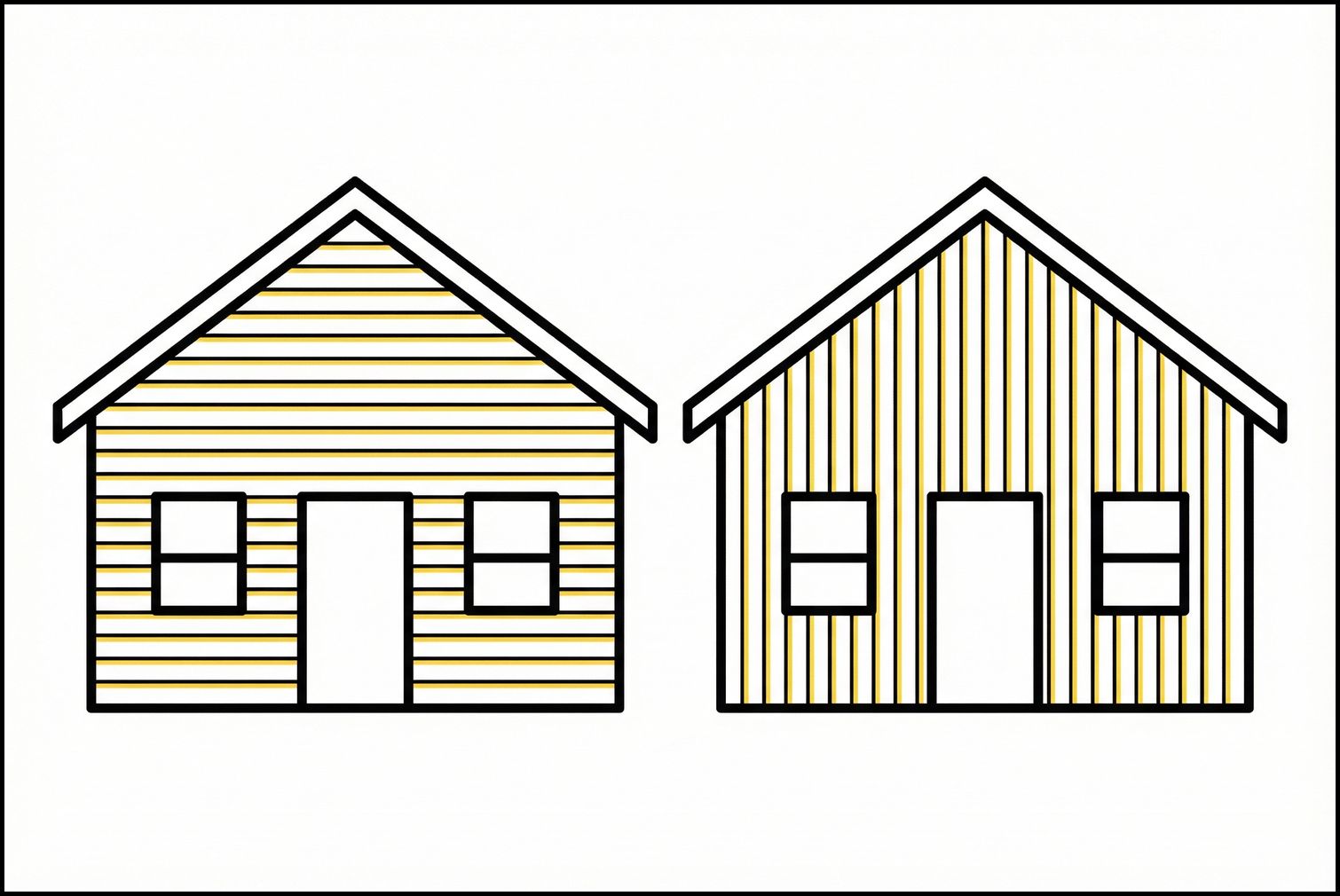
Horizontal lap works on almost everything. Colonial, ranch, Cape Cod, craftsman, traditional — horizontal siding is the default for a reason. It creates a grounded, proportional look that’s hard to get wrong. For resale, horizontal lap is the conservative choice that appeals to the broadest range of buyers.
Vertical siding makes a statement. It draws the eye upward, making walls appear taller and emphasizing vertical architectural elements. Vertical works particularly well on:
- Modern farmhouse — board-and-batten (a type of vertical siding) is the signature exterior treatment
- Contemporary homes — clean vertical lines complement flat or low-slope rooflines
- Gable accents — vertical siding on gable ends with horizontal on the main walls adds visual variety
- Garages and outbuildings — vertical panels suit utilitarian structures
The trend toward mixed orientations is worth considering. Using horizontal lap on the main body of your home with vertical siding on gable ends, dormers, or accent sections creates architectural interest without the resale risk of an all-vertical exterior. This is one of the most common approaches we see in siding projects across Columbia.
Maintenance Considerations
Horizontal lap: Maintenance concentrates at the overlap points. Check annually for lifted boards, cracked caulk at butt joints, and paint peeling at overlaps where moisture contact is highest. Cleaning is straightforward — a garden hose or light pressure wash from top to bottom follows the board direction naturally.
Vertical siding: Maintenance focuses on the vertical seams between panels. Caulk and batten strips at these joints need inspection for gaps, especially after temperature swings that cause expansion and contraction. Vertical panels can accumulate more visible dirt streaking because rain runs straight down and carries debris with it. Cleaning requires attention to those vertical streaks.
In Mid-Missouri’s climate with its freeze-thaw cycles, both orientations need caulk inspection at least once a year. The temperature swings between a 95-degree August afternoon and a -5-degree January night put significant stress on sealant joints regardless of siding direction.
Board-and-Batten: The Most Popular Vertical Style
If you’re drawn to vertical siding, board-and-batten is likely what caught your eye. Wide boards are installed vertically with narrow batten strips covering the seams between them. The result is a rhythmic pattern of wide-narrow-wide that reads as distinctly vertical without the institutional look of flat panel siding.
We’ve covered board-and-batten in detail in our board-and-batten vs lap siding comparison, including cost breakdowns and when it makes sense for Mid-Missouri homes. If board-and-batten specifically is what you’re considering, that comparison has the deep-dive.
What a Siding Orientation Inspection Actually Covers
Before anyone commits to lap or vertical, a real siding estimate walks the exterior wall by wall. The point isn’t just quoting a price — it’s matching the orientation to how your home is built, how water currently moves across it, and what’s behind the existing material. Here’s what that visit should cover.
Wall geometry and height. Tall, narrow walls read differently in vertical siding than short, wide ones. An estimator who pays attention to this will point out which walls benefit from each orientation before you pick one for the whole house. A two-story wall with board-and-batten draws the eye up; that same profile on a low ranch can look heavy.
Existing overlap, housewrap, and flashing condition. If you’re re-siding rather than building new, the inspection checks whether the current overlap, housewrap, and flashing are doing their job. Water staining or soft spots behind old siding tell a different story than the orientation debate alone — and they can change whether a full tear-off is in scope before any new material goes up.
Trim, corners, and transition points. Vertical and horizontal siding meet windows, doors, and corners differently. Inside corners, outside corners, and window casing all need compatible trim. The estimate should call out trim upgrades or transition pieces that change the labor and material count, not just the board price.
Gable ends and accent walls. These are where mixing orientations is most common and most cost-effective. A good estimator will show you where vertical siding on a gable end or dormer adds visual interest without the cost of re-doing an entire wall system.
Fastening surface check. If vertical siding is on the table, the inspection confirms whether horizontal furring strips are needed over your sheathing. That single detail changes the labor estimate and the timeline — and it’s why a phone quote for “vertical siding” is rarely reliable.
Photos and measurements, wall by wall. Every elevation should be photographed and measured during the visit. Those photos become the scope document your written estimate is built from. If an estimate arrives without that level of detail, the orientation recommendation is a guess, not a measurement.
Frequently Asked Questions
Is horizontal or vertical siding better for resale value?
Horizontal lap siding is the safer choice for resale. It appeals to the widest range of buyers and matches the most architectural styles. Vertical siding can add value on homes where it suits the architecture (farmhouse, modern), but it limits your buyer pool more than horizontal does.
Can you mix horizontal and vertical siding on the same house?
Yes, and it’s one of the most effective ways to add architectural interest. Common combinations include horizontal on the main walls with vertical on gable ends, dormers, or accent sections. The key is using the same material and color family so the mix looks intentional.
Does vertical siding cost more than horizontal?
Material costs are similar or sometimes lower for vertical panels. But vertical installation often requires horizontal furring strips over the sheathing, which adds $1-2 per square foot in material and labor. Total installed cost is usually comparable between the two orientations.
Which siding orientation handles wind better?
Vertical siding generally provides better resistance to wind uplift because there are no horizontal overlaps for wind to catch. Horizontal lap siding can be vulnerable to wind-driven rain pushing moisture under the overlaps, especially during the severe thunderstorms common in Mid-Missouri from April through June.
What’s the best siding orientation for a farmhouse look?
Board-and-batten (vertical) on the main body with horizontal accents on covered porches or lower sections. This combination has become the signature farmhouse exterior treatment. James Hardie’s HardiePanel with batten strips or LP SmartSide vertical panels both achieve this look in durable fiber cement. Call us at (573) 424-9008 to explore options for your home.
Ready to Get Started?
We’ve been serving Mid-Missouri homeowners since 2010 with premium siding installation in both horizontal and vertical orientations. As James Hardie Preferred contractors, we have specialized training on every HardiePlank and HardiePanel profile — and the experience to help you choose the right combination for your home’s architecture and your curb appeal goals.
Get Your Free Siding Consultation:
- Call: (573) 424-9008
- Visit: 3504 Interstate 70 Drive SE, Columbia, MO 65201
Service Areas: Columbia, Jefferson City, Lake Ozark, Fulton, and throughout Mid-Missouri.
