
Should Gutter Guards Be Installed Under Shingles?
Key Takeaways:
- Most roofing professionals recommend against installing gutter guards under your shingles unless the product is specifically designed for it.
- Fastening through shingles will void your roof warranty — GAF, Owens Corning, and CertainTeed all prohibit penetrating shingle material with screws or nails.
- “Floating” installation methods exist that slide gently under the first row of shingles without fasteners, adhesive breaking, or shingle lifting.
- The safest approach is gutter-mounted guards that clip or screw to the gutter lip and fascia board with zero roof contact.
- Improper installation can cause water damage — lifted shingles redirect water behind the gutter and onto your fascia board and roof deck.
Why This Question Matters More Than You’d Think
When you’re getting quotes for gutter guard installation in Columbia or Jefferson City, one detail that doesn’t always come up in the sales conversation is how the guard attaches to your roof. Some products clip to the gutter lip. Others screw into the fascia board. And some slide underneath your bottom row of shingles.
That installation method isn’t just a technicality — it can affect your roof warranty, your shingle performance during high winds, and whether water actually reaches your gutter or ends up behind it on your fascia board. For Mid-Missouri homes that deal with spring hail, summer storms, and winter ice, getting this detail wrong creates problems you won’t notice until damage has already started.
What Happens When Guards Go Under Shingles
The idea behind under-shingle installation makes sense in theory. Sliding the back edge of the guard underneath the first row of shingles creates a seamless transition from roof surface to guard surface. Water flows off the shingles, across the guard, and into the gutter. Debris slides off the angled guard and falls to the ground.
The problem is what happens to the shingles during and after installation. Roofing engineers note that lifting shingles breaks the manufacturer’s adhesive seal — the tar strip that bonds each shingle to the one below it. That seal exists for wind resistance. Once broken, shingles are more vulnerable to lifting during storms, which exposes the underlayment and roof deck to water.
There’s also a backflow risk. If the guard doesn’t pitch at exactly the right angle, heavy rain can ride up the guard surface and flow backward under the shingles instead of dropping into the gutter. In a region like Mid-Missouri where 2-inch-per-hour rain rates aren’t uncommon during spring thunderstorms, that backflow can send significant water volume onto your fascia board and roof deck.
What Manufacturers Actually Say About Warranty
GAF has addressed this directly: their Limited Warranty covers manufacturing defects, and in most cases, properly installed gutter guards do not void it. But GAF draws clear lines. They prohibit:
- Penetrating shingles with fasteners (screws, nails, or staples through shingle material)
- Removing and replacing shingles to install guard brackets
- Removing the drip edge
- Installing guards under the underlayment or felt paper
- Significantly bending or lifting shingles beyond their natural flex
Owens Corning and CertainTeed take similar positions. The common thread: any installation that damages, penetrates, or permanently deforms the shingle voids your warranty coverage for that section of roof.
This matters because a full roof replacement on a Mid-Missouri home runs $8,000-$15,000 or more. A $3,000 gutter guard installation that voids your roof warranty is a bad trade.
Three Installation Methods Compared
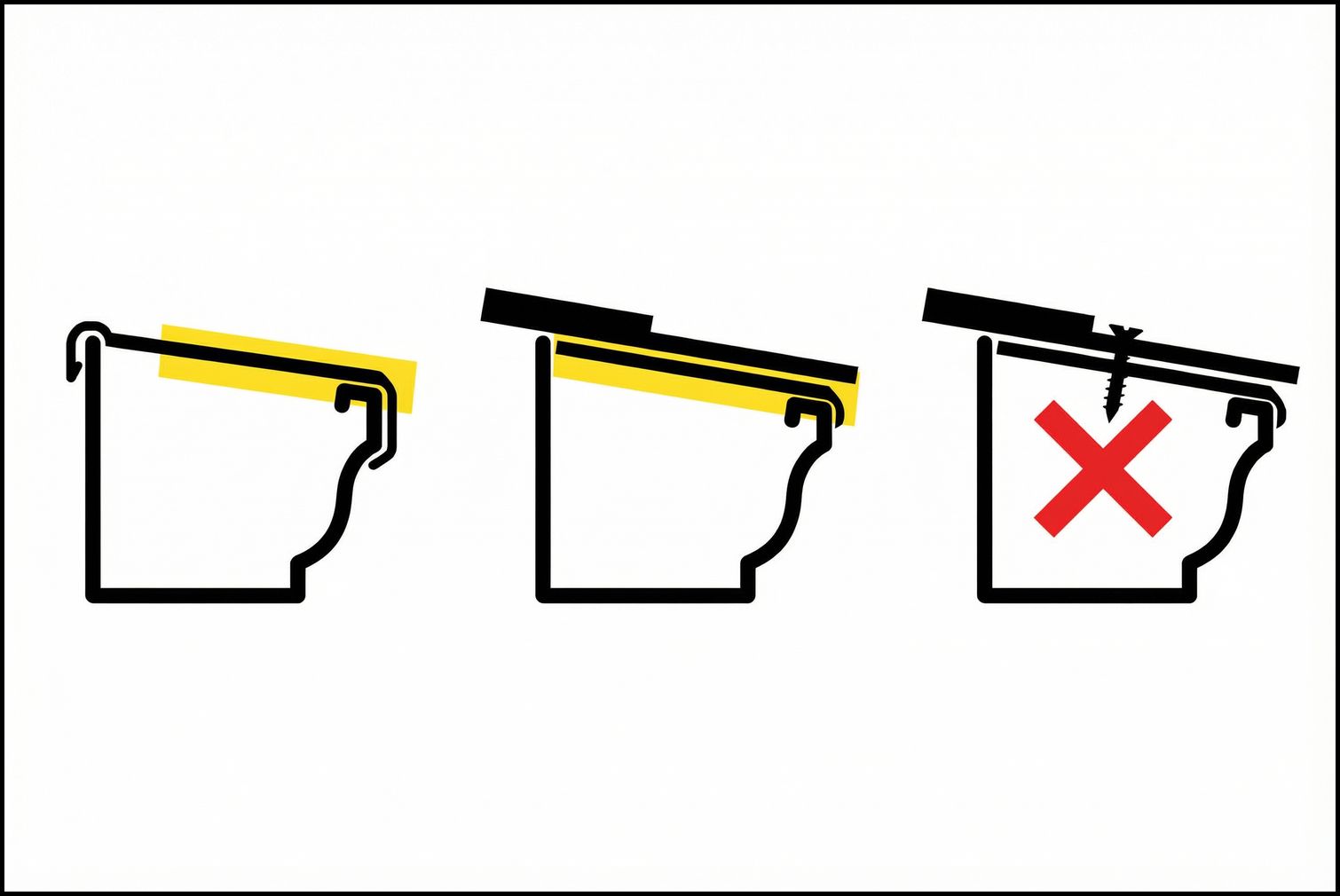
| Method | How It Works | Warranty Safe? | Best For |
|---|---|---|---|
| Gutter-lip mount | Clips or screws to the front edge of the gutter only | Yes — zero roof contact | Screen guards, basic mesh |
| Floating under-shingle | Back edge slides under first shingle row with no fasteners; front attaches to gutter lip | Usually yes — if no adhesive seal is broken | Premium micro-mesh systems |
| Fastened under-shingle | Screws or brackets penetrate through shingles into roof deck | No — voids warranty | Reverse-curve and solid-cap guards |
The floating method is the middle ground that some premium products have validated with roofing manufacturers. These guards pitch at the same angle as the roof, don’t use fasteners on the roof side, and don’t lift shingles enough to break the adhesive seal. Several manufacturers have obtained written approval letters from GAF, Owens Corning, and CertainTeed confirming their floating installation doesn’t affect warranty coverage.
What We Recommend for Mid-Missouri Homes
When we install roofing systems in Columbia and throughout Mid-Missouri, we pay attention to how every component interacts — including gutter guards. Our general guidance:
Preferred: Gutter-lip mounted guards. These attach entirely to the gutter and fascia with no roof contact. They’re the safest option for your roof warranty, the easiest to remove for maintenance, and they work well with the seamless aluminum gutters common on Mid-Missouri homes.
Acceptable: Floating under-shingle systems from manufacturers who have written approval from your shingle manufacturer. If you go this route, verify the approval letter covers your specific shingle product line — not just the brand in general.
Avoid: Any system that requires fasteners through your shingles or removal of your drip edge. The short-term convenience isn’t worth the warranty risk, especially in a hail-prone area where you may need to file a roof damage claim within the guard’s lifetime.
The Drip Edge Factor
Some gutter guard installers remove the drip edge — the metal strip along your roof’s lower edge that directs water into the gutter — to create a flush mounting surface. This is a problem for two reasons.
First, removing the drip edge voids most shingle warranties outright. GAF, Owens Corning, and CertainTeed all require drip edge as part of a complete roofing system.
Second, the drip edge serves a structural purpose beyond directing water. It prevents wind-driven rain from getting under your shingles at the eave, and it keeps the fascia board dry during normal rainfall. Removing it to install a gutter guard trades one form of protection for another — and you end up with less protection overall.
Common gutter guard installation mistakes include removing or bending the drip edge, using oversized fasteners that crack shingles, and failing to maintain proper pitch for debris shedding. Any reputable installer should be able to work with your existing drip edge, not around it.
Questions to Ask Your Installer
Before signing a gutter guard contract, ask these specific questions:
- “Does your product attach to my shingles or my gutter?” — The answer should be “gutter and/or fascia.” If they mention roof deck fasteners, ask about warranty implications.
- “Will you remove or modify my drip edge?” — The answer should be no.
- “Do you have a written approval letter from my shingle manufacturer?” — If they install under shingles, they should be able to produce this.
- “What happens if I need a roof replacement in 5 years?” — Good guards should be removable and reinstallable without damage.
Frequently Asked Questions
Will gutter guards void my roof warranty?
Not automatically. Guards that attach only to the gutter or fascia with no roof contact don’t affect your warranty. Guards that require fasteners through shingles, shingle removal, or drip edge removal will void warranty coverage for the affected area. Check your shingle manufacturer’s specific position before installation.
Should gutter guards be installed over or under the drip edge?
Over. The drip edge should remain in place with the gutter guard mounted on top of or in front of it. Removing or bending the drip edge voids most roof warranties and reduces water management performance at the eave line.
Can gutter guards cause roof leaks?
Improperly installed guards can. If shingles are lifted enough to break the adhesive seal, water can penetrate during wind-driven rain. If the guard’s pitch sends water backward under the shingles instead of into the gutter, water reaches the fascia and roof deck. Properly installed guards don’t cause leaks.
Do I need to remove gutter guards for a roof replacement?
Yes. Any guard system — whether gutter-mounted or under-shingle — needs to be removed during a roof replacement. Quality guards can be reinstalled after the new roof is complete. Ask your roofing contractor about guard removal and reinstallation costs as part of the replacement estimate.
What type of gutter guard is safest for my roof?
Guards that mount entirely to the gutter lip or fascia board are the safest for your roof warranty and shingle integrity. If you prefer under-shingle placement, choose a product with written manufacturer approval from your specific shingle brand. Call us at (573) 424-9008 to discuss which option fits your home.
Ready to Get Started?
We’ve been serving Mid-Missouri homeowners for over 25 years with premium roofing and exterior solutions. As GAF Master Elite, OC Platinum Preferred, and James Hardie Elite Preferred contractors, we understand how every component of your roof system works together — including gutter guards.
Get Your Free Inspection:
- Call: (573) 424-9008
- Visit: 3504 Interstate 70 Drive SE, Columbia, MO 65201
Service Areas: Columbia, Jefferson City, Lake Ozark, Fulton, and throughout Mid-Missouri.
