Casement Windows in Jefferson City, MO: Types, Benefits & Costs
Key Takeaways
- Casement windows are hinged on the side and crank open outward — giving you full-pane ventilation and a tight seal when closed, which makes a real difference in Jefferson City’s hot, humid summers and cold winters.
- Common frame materials are vinyl, fiberglass, wood, and aluminum. For Mid-Missouri’s climate swings, vinyl and fiberglass tend to hold up best without constant upkeep.
- Installed costs in the Jefferson City area typically run $400–$1,200 per window, depending on size, material, and glazing options.
- Casements pair especially well with older homes near the Capitol area and craftsman-style builds where the clean sightlines complement the architecture.
- Professional installation matters for energy performance — a casement that isn’t plumb and properly sealed won’t deliver on its efficiency promise.
- If you’re weighing new windows for your Jeff City home, window replacement in Jefferson City is something our team handles from consultation through installation.
Understanding Casement Windows

An illustration of various casement windows showcasing their features.
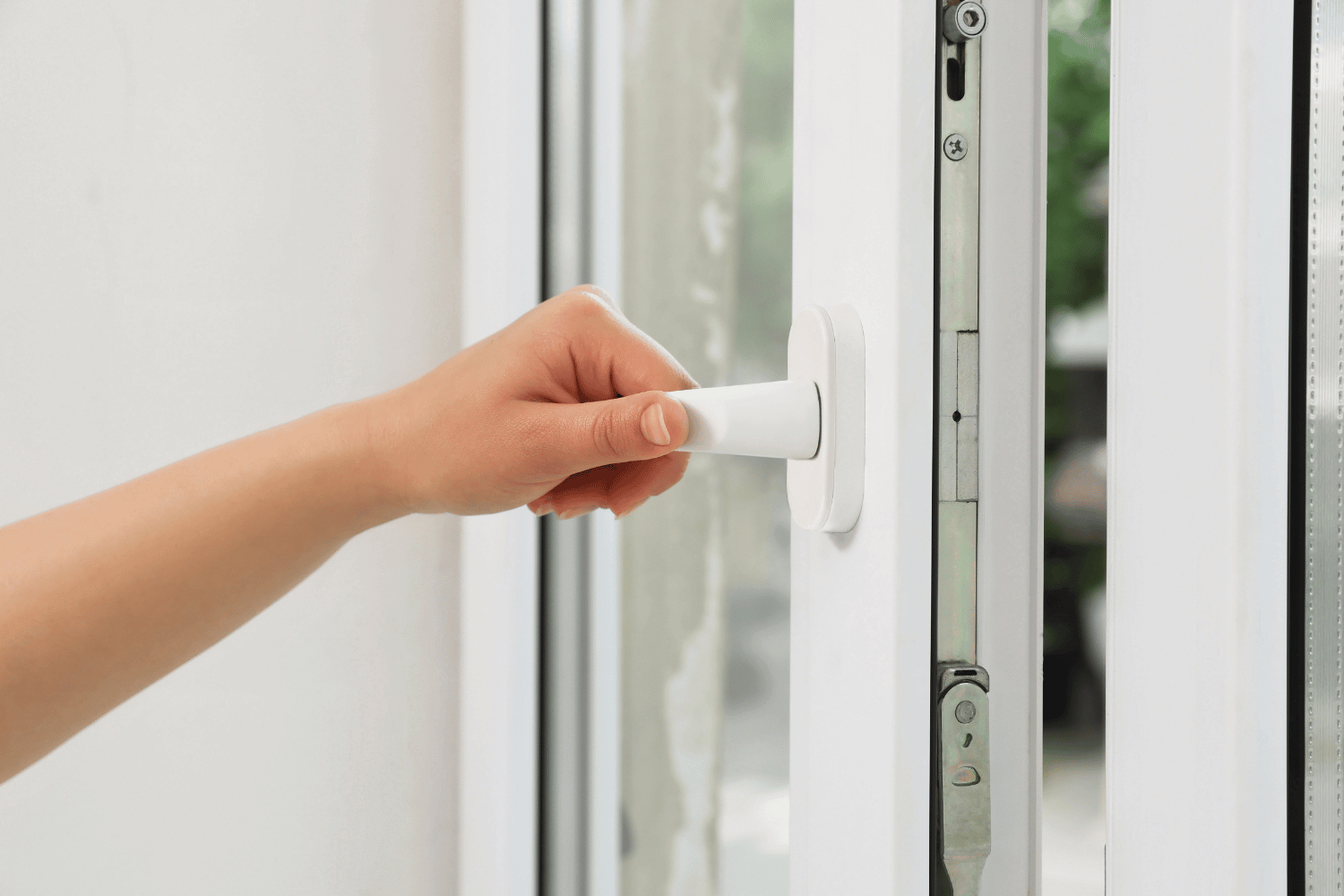
A casement window is hinged on one vertical side — left or right — and swings outward when you turn a crank handle at the bottom of the frame. Unlike double-hung windows, which slide up and down, a casement opens its entire pane to the outdoors. That means more airflow per square foot of window than almost any other style.
The crank mechanism closes the sash tightly against the frame, compressing the weatherstripping on all four sides. That compression seal is part of why casements test so well for air infiltration. When the window is locked, it’s genuinely locked — there’s no gap for drafts to sneak through the way there is with sliding or double-hung windows.
In Jefferson City’s climate, that matters. Summers here are muggy and hot — daytime highs regularly push into the mid-90s in July and August. Winters bring wind chill and ice storms that can stack up fast, especially in the river corridor. A window that seals tightly isn’t a luxury; it’s what keeps your HVAC system from working twice as hard.
How Casements Differ from Other Window Styles
Double-hung windows are the most common style in Mid-Missouri homes, and they’re versatile. But they only open about 50% of their frame — half goes up, half stays fixed. Casements open 100% of the frame area. If you’re catching a cross-breeze on a nice fall evening before the first freeze, that difference is noticeable.
Awning windows are close cousins — they’re hinged at the top and open outward at the bottom. You’ll see them stacked below casements in some designs, or used in basement openings. Picture windows are fixed (they don’t open at all) and prioritize views over ventilation. Sliding windows operate horizontally and tend to have looser seals than casements over time as the tracks wear.
Types of Casement Windows
Standard Single Casement
One sash, one crank, one frame. This is the most straightforward version — useful for narrow openings, stairwells, and spots where you want ventilation but have limited width. Common in older Jefferson City homes where window openings were built to specific rough-opening dimensions.
French Casement
Two sashes that meet in the middle without a center post. Both open outward from the center, giving you an unobstructed view when they’re open. The trade-off: no center lock point, so the weatherstripping has to work a little harder. French casements look great in dining rooms and living spaces where the view matters as much as the ventilation.
Push-Out Casement
No crank mechanism — you push the sash open by hand and latch it at the desired angle. Simpler mechanically, which means fewer moving parts to wear out. Less common in the Jefferson City market, but worth knowing about if you want a more traditional European aesthetic.
Bow and Bay Window Combinations
Casements are frequently used as the operable flanking units in bay and bow window configurations. The center section is usually a fixed picture window for maximum view, and the casement sashes on either side provide the ventilation. This arrangement is popular in living rooms and master bedrooms throughout neighborhoods like Wardsville, Jefferson Crossing, and the older subdivisions near Holts Summit.
Benefits of Casement Windows for Jefferson City Homes

A sunny room with open casement windows providing fresh air.
Ventilation
This is casements’ biggest practical advantage. Because the entire sash swings open, you can angle the window to act like a wind scoop — catching airflow that would slide past a partially-open double-hung. On pleasant days in April or October when you’d rather not run the AC or heat, that extra airflow is welcome.
Energy Efficiency
The compression seal is the key. When you crank a casement closed and engage the lock, the sash presses firmly against the frame on all sides. Air infiltration drops significantly compared to windows that rely on sliding contact between sash and frame. For a Jefferson City home trying to hold heat in during a January ice storm — or keep cool air in during a July heat wave — that sealed perimeter is a meaningful advantage.
Look for casements with Low-E coatings and argon or krypton gas fills between the panes. In Missouri’s climate, the right glazing combination can meaningfully reduce solar heat gain in summer while still allowing passive warming in winter.
Unobstructed Views
Casements have no horizontal rail dividing the sash the way double-hung windows do. The only interruption to your sightline is the vertical frame on either side. If you’re on a lot with a decent view — whether that’s the Missouri River bluffs, a wooded backyard, or the Capitol dome from the right angle — casements maximize it.
Security
The crank-and-lock mechanism on a casement makes it harder to force open from outside than a sliding or double-hung window. The sash presses against the frame all the way around, and the multi-point locking hardware on quality units is genuinely difficult to defeat without breaking the glass. For ground-floor windows in Jefferson City neighborhoods, that’s not a trivial consideration.
Some casement lines also offer sash locks that engage at multiple points along the frame, not just at the handle. If security is a specific concern for a first-floor bedroom or a window facing a side yard, ask about multi-point locking options when you’re comparing products.
Easy Cleaning
Both panes of a casement — inside and outside — can typically be reached by rotating the sash out and cleaning through the opening. On a two-story home, that eliminates the need for a ladder to clean exterior glass on upper-floor windows. It’s a small thing, but homeowners who’ve dealt with second-floor double-hungs appreciate it.
Potential Drawbacks to Know
No window style is perfect for every situation. Casements have real limitations worth understanding before you commit.
They can’t be used with window air conditioning units — the crank mechanism and outward swing won’t work with a box AC. If you have rooms that rely on window AC and you’re not ready to upgrade to central air, casements aren’t the right fit for those openings.
The crank mechanism adds a point of mechanical wear that double-hung windows don’t have. On lower-quality units, cranks strip or seize up over time. On quality windows with proper installation, this isn’t a common problem — but it’s worth asking about when comparing products.
Casements that open over a patio, walkway, or deck can be inconvenient. The swinging sash takes up exterior space when open. On tight lots or where windows are positioned close to high-traffic areas, this is worth thinking through during the planning stage.
Casement Window Materials
Different materials used for casement windows including wood and vinyl.
Vinyl
Vinyl is the most common choice in Jefferson City and the surrounding area — and for good reason. It doesn’t rot, it doesn’t need painting, and it handles Missouri’s humidity without swelling or contracting the way wood does. A quality vinyl casement holds its shape and seal for decades with minimal maintenance. Color options are somewhat limited compared to other materials, but the most popular finishes (white, tan, bronze) are widely available.
Fiberglass
Fiberglass frames are dimensionally stable — they expand and contract at nearly the same rate as the glass itself, which means the seal stays tighter over time. They’re stronger than vinyl and can be painted to match virtually any trim color. Fiberglass costs more than vinyl upfront, but it’s the right call for homeowners who want maximum performance and plan to stay in their home long-term. For historic homes near Jefferson City’s Old Town or along Lafayette Street, the ability to paint fiberglass frames to match original trim profiles is a real advantage.
Wood
Wood casements are beautiful. There’s no manufacturing process that fully replicates the warmth and character of real wood grain. But wood in Missouri’s climate requires commitment. The humidity cycles here — wet springs, dry spells, humid summers — cause wood to move. Without regular painting or staining and prompt attention to any moisture intrusion, wood frames can rot at the joints within a decade. Wood-clad windows (wood interior, aluminum or fiberglass exterior) are a reasonable middle ground if you want the interior aesthetic without the exterior maintenance burden.
Aluminum
Aluminum frames are slim, strong, and good-looking in modern or commercial applications. The drawback for residential use in Jefferson City is thermal performance — aluminum is a natural heat conductor, which means frames can transfer cold in winter and heat in summer without a proper thermal break. Aluminum with a quality thermal break is a different story, but it comes at a price. For most homeowners here, vinyl or fiberglass is a better value.
Casement Window Costs in Jefferson City, MO

A chart displaying the cost breakdown of casement windows.
Prices vary based on frame material, glass package, window size, and installation complexity. Here’s a realistic breakdown for the Jefferson City market in 2026:
- Vinyl casement (standard size, double-pane): $350–$650 per window installed
- Fiberglass casement: $600–$1,100 per window installed
- Wood or wood-clad casement: $700–$1,400 per window installed
- French casement (pair): $800–$1,800 installed, depending on material
Upgrading to triple-pane glass or specialty Low-E coatings adds $50–$150 per window, which is usually worth it in Missouri’s climate given the energy savings over time.
For a full-home window replacement on a typical Jefferson City home — say, 10–15 windows — you’re looking at $5,000–$18,000 depending on material tier and project complexity. Homes with non-standard rough openings, damaged framing around existing windows, or historic trim details that need to be preserved will sit toward the higher end.
The most accurate way to understand what your specific project will cost is to have someone walk through the home with you. Our team handles Jefferson City window replacement services and can put together a detailed, no-pressure estimate based on your actual openings, not a per-window average.
Professional Installation vs. DIY
Casement windows can technically be installed by a skilled DIYer. The mechanics aren’t complicated — you’re removing the old window, prepping the opening, setting and shimming the new unit, securing it, and sealing around the exterior. If you’ve done it before and you have the right tools, it’s manageable.
That said, there are real reasons most Jefferson City homeowners hire a professional for this work.
First, fit is everything. A casement that isn’t perfectly plumb and level won’t operate correctly — the crank will bind, or the sash won’t compress evenly against the frame. Those are performance issues that defeat the entire point of choosing a casement. Getting the shim spacing right takes experience.
Second, the exterior seal has to be done correctly. Water infiltration around window frames is one of the most common sources of hidden damage in Missouri homes. A bad perimeter seal leads to moisture getting into the rough opening, and from there into framing and insulation. The damage isn’t always visible until it’s already expensive.
Third, manufacturer warranties on most quality window brands require professional installation. If you self-install and have a product issue, the warranty may not cover it.
If you’re replacing a single window that’s an easy swap — same rough opening, no frame damage, straightforward exterior trim — DIY is more defensible. A full-home window replacement is a different conversation.
Are Casement Windows Right for Your Jefferson City Home?
Casements make the most sense when you want maximum ventilation and energy efficiency from a window that doesn’t interrupt sightlines. They work particularly well in:
- Kitchens and bathrooms, where ventilation is a priority and you want to catch airflow while cooking or after a shower
- Living rooms and dining rooms where the view is worth protecting
- Bedrooms on upper floors where easy exterior cleaning is a practical benefit
- Historic or craftsman-style homes where the clean sash lines complement the architecture
They’re a harder fit in rooms where window AC is used, over patios or walkways with tight clearances, or in openings so wide that a single casement sash becomes unwieldy. In those situations, double-hung or sliding windows are usually the better call.
One thing worth knowing: casements can look significantly different from the street depending on the grille pattern you choose. A colonial grille (small divided-light squares) reads traditionally and fits in well with Jefferson City’s older residential areas. A prairie-style perimeter grille pairs well with craftsman architecture. No grilles at all gives you the cleanest, most modern look. This is more of a design conversation than a performance one, but it’s worth having before you finalize an order.
The other factor is your existing window configuration. Most Jefferson City homes were built with double-hung windows, and swapping to casements usually means working within the same rough opening — which is generally straightforward. Occasionally, a frame swap reveals moisture damage or rot in the surrounding framing, which needs to be addressed before the new window goes in. A good installer will flag that before it becomes a surprise.
Summary
Casement windows are a strong performer for Missouri homeowners who prioritize ventilation, energy efficiency, and clean sightlines. The compression seal makes them among the tightest windows on the market — an advantage that pays off through every Jefferson City winter and summer. Vinyl and fiberglass are the most practical frame choices for this climate. Installed costs run $350–$1,400 per window depending on material and complexity, with most whole-home projects landing between $5,000 and $18,000.
They’re not the right window for every situation, but where they fit, they’re hard to beat.
Frequently Asked Questions
Are casement windows a good choice for older Jefferson City homes?
Yes, generally. Many older homes near the Capitol area and in established Jefferson City neighborhoods were built with standard rough-opening sizes that accept modern casement frames without modification. The clean lines of a casement complement both craftsman and colonial architecture well. The main thing to check is whether the existing frames have moisture or rot damage — older caulking and trim tend to let water in over time, and a window replacement is the right moment to address that before it gets worse.
How do casement windows handle Missouri’s ice storms?
Well, provided they’re quality units with proper installation. The compression seal on a casement is inherently better at blocking cold air infiltration than sliding-style windows. Look for windows with thermally broken frames and insulated glass — Low-E coatings and argon fill are worth the upgrade in Mid-Missouri’s freeze-thaw climate. Ice accumulation on the exterior crank hardware can be an issue in extreme events, but it’s rarely a practical problem with modern hardware designs.
Do casement windows increase home value in Jefferson City?
Window replacements typically recoup 60–75% of their cost at resale, according to national remodeling cost-value studies. In Jefferson City’s market, buyers notice energy-efficient windows — especially on older homes where drafty single-panes are common. Casements signal a quality upgrade over standard double-hungs, which can be a positive differentiator when listing. That said, window replacement is primarily a comfort and efficiency investment rather than a pure ROI play.
How long do casement windows last in Missouri’s climate?
A quality vinyl or fiberglass casement, properly installed and maintained, will last 25–35 years in this climate. Wood frames in good hands can last longer, but they require more active maintenance. The hardware — cranks, hinges, locks — typically outlasts the frame if the window was made by a reputable manufacturer. If a crank mechanism fails on an otherwise sound window, it’s usually replaceable without swapping the entire unit.
Can I replace just one casement window, or do I need to do the whole house?
You can absolutely replace a single window. There’s no technical requirement to do all windows at once. The practical consideration is usually visual consistency — if your home has matching windows and you replace one with a slightly different profile or color, it may stand out. It’s also worth noting that many installers have minimum project sizes for scheduling purposes, so a single-window job sometimes costs proportionally more per unit than a multi-window project. Ask upfront.
What should I ask a Jefferson City window company before hiring them?
A few things worth covering: Are they licensed and insured in Missouri? Do they offer a separate workmanship warranty beyond the manufacturer’s product warranty? Will they handle permit applications if required by the city? Can they show you recent local projects or references? And specifically for casements — ask whether they have experience with the brand they’re recommending, since proper installation of the crank hardware and compression sealing is technique-dependent. A company that mostly installs double-hungs and occasionally does casements isn’t the same as one that does them regularly.
