
Mesh vs Foam Gutter Guards: Which Actually Works in Mid-Missouri?
Key Takeaways:
- Micro-mesh gutter guards outperform foam inserts in nearly every category — durability, debris filtration, and heavy rain handling.
- Foam gutter guards last 1-2 years before shrinking, crumbling, or clogging with trapped sediment and seeds.
- Mesh guards carry 25-30 year warranties; foam guards typically have no warranty at all.
- Neither option is maintenance-free — but mesh reduces cleaning frequency from twice a year to once every 2-3 years.
- Mid-Missouri’s spring storms and humid summers accelerate foam deterioration and make mesh the more practical long-term choice.
Two Very Different Approaches to the Same Problem
If you’ve been shopping for gutter protection in Columbia or Jefferson City, you’ve probably seen two options at opposite ends of the price range: foam gutter inserts that cost a few dollars per foot at the hardware store, and micro-mesh guard systems that run significantly more but promise decades of performance.
The price gap raises a fair question — is the mesh guard actually that much better, or is it just more expensive? The answer comes down to how each product handles water, debris, and time. And in Mid-Missouri, where spring delivers 2-inch rain bursts followed by humid summers that encourage mold growth, those differences matter more than they would in a dry climate.
Let’s walk through what each type actually does, where each one fails, and which makes sense for your home.
How Foam Gutter Guards Work (and Why They Stop Working)
Foam gutter guards are porous polyurethane or polyester inserts that sit inside your gutter channel. The idea is simple: water flows through the foam while leaves and debris sit on top and blow away. At $2-4 per foot, they’re the cheapest gutter protection available and easy to install yourself.
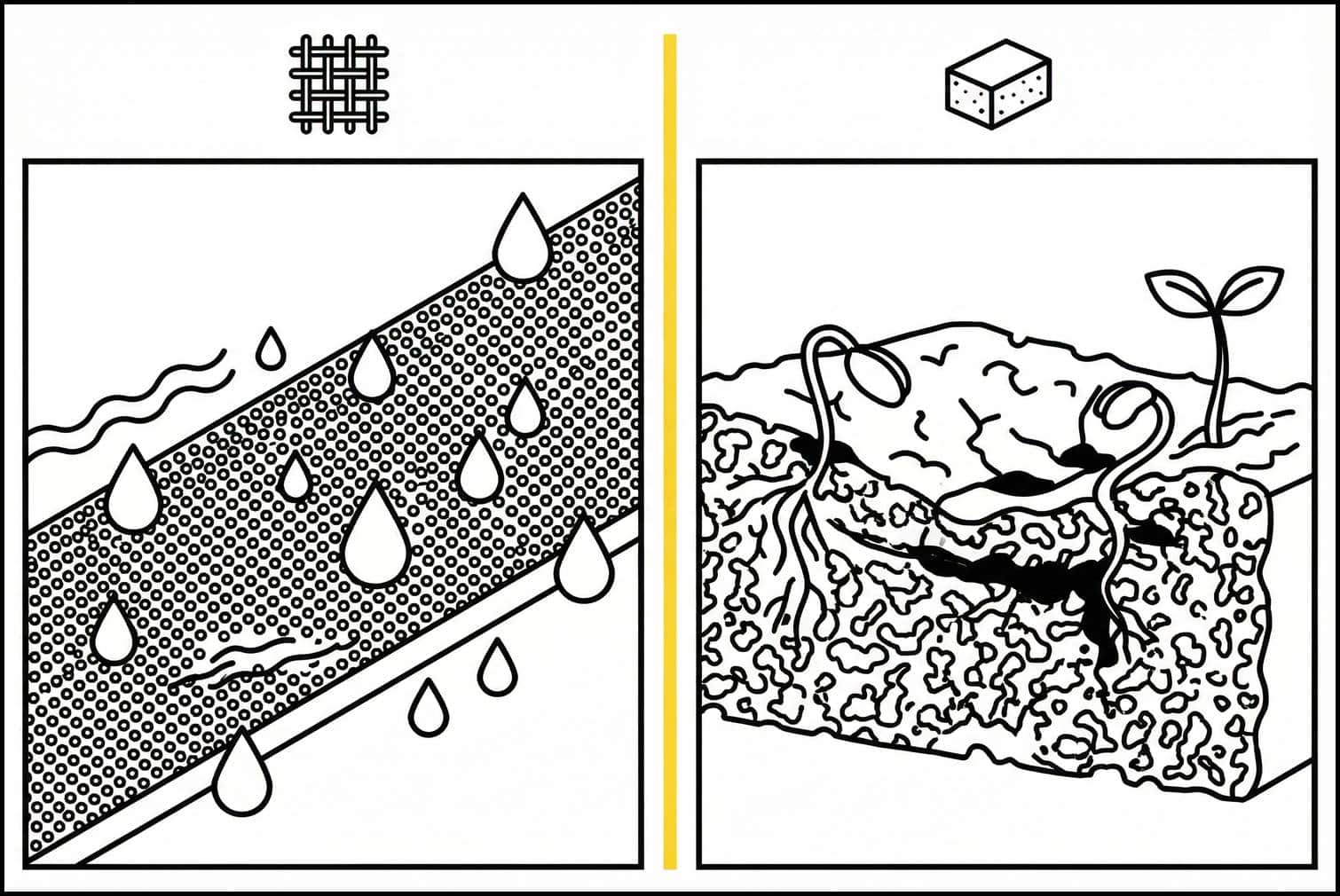
The problem is what happens after the first season. Foam is a sponge. It absorbs and holds water for days after a light rain. In Mid-Missouri’s humid summers, that trapped moisture creates conditions for mold, mildew, and algae to grow inside the foam itself. Seeds that land on top take root in the wet material. Dirt and roof grit work their way into the pores and never come out.
UV exposure from direct sunlight breaks down the foam’s cellular structure. Freeze-thaw cycles — which Columbia sees dozens of times between November and March — accelerate that breakdown further. Industry documentation on foam guard lifespan puts the realistic service life at 1-2 years before the material shrinks, crumbles, or becomes so clogged it actually blocks water flow instead of filtering it.
When foam guards fail, they often cause worse problems than having no guards at all. Water overflows the gutter because it can’t penetrate the clogged foam. The foam itself becomes a saturated weight sitting in your gutter channel, potentially causing sag. And removing degraded foam is messy — pieces break apart and leave residue that needs scrubbing.
How Micro-Mesh Gutter Guards Work
Micro-mesh gutter guards use a fine stainless steel screen — typically with openings between 400 and 600 microns — mounted on an aluminum frame that sits over or clips onto your existing gutter. Water passes through the mesh while debris of virtually any size stays on top.
The key difference from foam is that mesh guards don’t absorb anything. Water flows through and drops into the gutter below. Debris sits on the surface where wind, gravity, and the occasional rinse from your garden hose move it along. There’s no material for seeds to root in, no moisture reservoir for mold to colonize, and no cellular structure for UV or freeze-thaw cycles to destroy.
Quality micro-mesh products use surgical-grade stainless steel with hole sizes around 540 microns — small enough to block pine needles, roof sand grit, and shingle granules. These products meet ANSI/ARCSA standards for rainwater filtration and carry warranties ranging from 25 to 30 years.
The tradeoff is cost. Professional micro-mesh installation runs $15-45 per linear foot depending on the product and your roof configuration. For a typical Mid-Missouri home with 150-200 feet of gutter, that’s $2,250-$9,000 — a meaningful investment compared to $300-800 for DIY foam.
Head-to-Head Comparison
| Factor | Foam Inserts | Micro-Mesh Guards |
|---|---|---|
| Cost per linear foot | $2-4 (DIY) | $15-45 (installed) |
| Lifespan | 1-2 years | 25-30 years |
| Warranty | None or 1 year | 25-30 years |
| Handles heavy rain | Poor — clogs when saturated | Good — water passes through mesh |
| Handles pine needles | Poor — needles embed in foam | Excellent — sits on surface |
| Mold/mildew risk | High — retains moisture | Low — no moisture retention |
| Maintenance frequency | 2x/year minimum + replacement | Once every 2-3 years |
| Installation | DIY, 30 minutes | Professional, half day |
| UV/freeze-thaw resistance | Poor — material degrades | Excellent — stainless steel |
What Mid-Missouri Weather Does to Each Type
Central Missouri’s climate is particularly hard on foam gutter guards. Here’s why the local conditions matter:
Spring rain intensity: Columbia averages 42 inches of rain per year, with the heaviest downpours arriving in April through June. When 2 inches of rain falls in 30 minutes — not unusual during a spring thunderstorm — foam guards can’t drain fast enough. The foam saturates and water sheets over the gutter edge, defeating the entire purpose. Mesh guards handle high-volume water flow because the screen doesn’t absorb anything.
Humidity and mold: Mid-Missouri summers bring weeks of 80%+ humidity. Foam guards that absorbed water during a Tuesday afternoon storm may still be damp on Friday. That sustained moisture creates ideal conditions for mold colonies inside the foam. Mesh guards dry almost instantly because there’s no absorbent material.
Freeze-thaw cycles: Between November and March, temperatures in Columbia regularly swing above and below freezing — sometimes within the same day. Water trapped in foam expands when it freezes, breaking down the cellular structure from the inside out. After one or two winters, foam inserts often look shredded. Stainless steel mesh is unaffected by freeze-thaw cycles.
Hail and debris: With 79+ hail reports within 10 miles of Columbia in a typical year, shingle granules wash into gutters constantly after storms. Foam traps those granules permanently. Mesh allows granules to wash through with the next rain.
The Real Cost Comparison Over 10 Years
Foam looks cheaper upfront, but the math changes when you account for replacement cycles:
Foam over 10 years: At $3/foot for 175 feet of gutter, that’s $525 per installation. Replacing every 1.5 years means roughly 6-7 replacements over a decade: $3,150-$3,675 in materials alone, plus your time on a ladder each time. If you hire someone for the removal and reinstallation, add $200-400 per visit.
Micro-mesh over 10 years: A one-time professional installation at $25/foot for 175 feet costs $4,375. Over the next decade, maintenance consists of a garden hose rinse once every 2-3 years — maybe 4 times total. The guards are still under warranty at year 10 with decades of life remaining.
By year 5-6, foam has already cost as much as mesh. By year 10, foam has cost more while delivering worse performance the entire time.
When Foam Might Make Sense
To be fair, foam gutter guards aren’t always the wrong choice. They can work as a temporary solution while you budget for a permanent system. If you’re selling a home within the next year and just need clean gutters for inspections, foam covers the gap. And for detached outbuildings like sheds or workshops where gutter performance isn’t critical, foam’s low cost is proportional to the stakes.
But for your primary home’s gutter system — the one protecting your foundation, siding, and landscaping from water damage — foam is a temporary fix that creates long-term problems.
What Home Inspectors Say About Gutter Guards
Home inspection standards from InterNACHI make an important point that applies to both types: covered gutter systems may be effective in reducing debris buildup, but they are not maintenance-free. No gutter guard — mesh, foam, screen, or reverse-curve — eliminates the need for periodic inspection.
NC State Extension recommends inspecting gutters yearly and after major weather events regardless of what protection system you have installed. The difference is what you find during those inspections. With mesh guards, you’re typically brushing off surface debris. With foam, you’re often discovering the guard itself has become the problem.
Frequently Asked Questions
Do foam gutter guards work in heavy rain?
Poorly. Foam absorbs water like a sponge, and once saturated, additional rainfall sheets over the top of the gutter instead of flowing through it. During the intense spring downpours common in Mid-Missouri, foam guards frequently cause overflow rather than prevent it.
How long do micro-mesh gutter guards last?
Quality micro-mesh systems with stainless steel screens typically last 25-30 years. Most manufacturers back this with a warranty covering the same period. The stainless steel mesh resists corrosion, UV degradation, and freeze-thaw damage that destroys other guard types.
Can I install micro-mesh gutter guards myself?
Some products are designed for DIY installation, though most homeowners benefit from professional installation to ensure proper pitch, secure mounting, and correct overlap at joints. Improper installation can create gaps where debris enters or sections where water overshoots the gutter.
Do gutter guards eliminate the need for gutter cleaning?
No gutter guard eliminates maintenance entirely. Mesh guards reduce cleaning frequency from twice a year to roughly once every 2-3 years. Foam guards may actually increase maintenance because the foam itself needs periodic removal, rinsing, and eventual replacement.
Are foam gutter guards bad for my gutters?
They can be. Saturated foam adds weight to your gutter channel, potentially causing sag over time. Trapped moisture accelerates corrosion on aluminum gutters. And decomposing foam leaves residue that’s difficult to clean without removing the guards entirely.
What type of gutter guard works best in Missouri?
For Mid-Missouri’s combination of heavy spring rain, humid summers, and freeze-thaw winters, micro-mesh guards with stainless steel screens deliver the best long-term performance. They handle high water volume without clogging, resist mold growth, and survive decades of temperature swings. Call us at (573) 424-9008 to discuss options for your home.
Ready to Get Started?
We’ve been protecting Mid-Missouri homes for over 25 years with premium exterior solutions — including gutter installation and gutter guard systems throughout Columbia, Jefferson City, and the surrounding area. As GAF Master Elite, OC Platinum Preferred, and James Hardie Elite Preferred contractors, we bring certified expertise to every project.
Get Your Free Gutter Inspection:
- Call: (573) 424-9008
- Visit: 3504 Interstate 70 Drive SE, Columbia, MO 65201
Service Areas: Columbia, Jefferson City, Lake Ozark, Fulton, and throughout Mid-Missouri.
