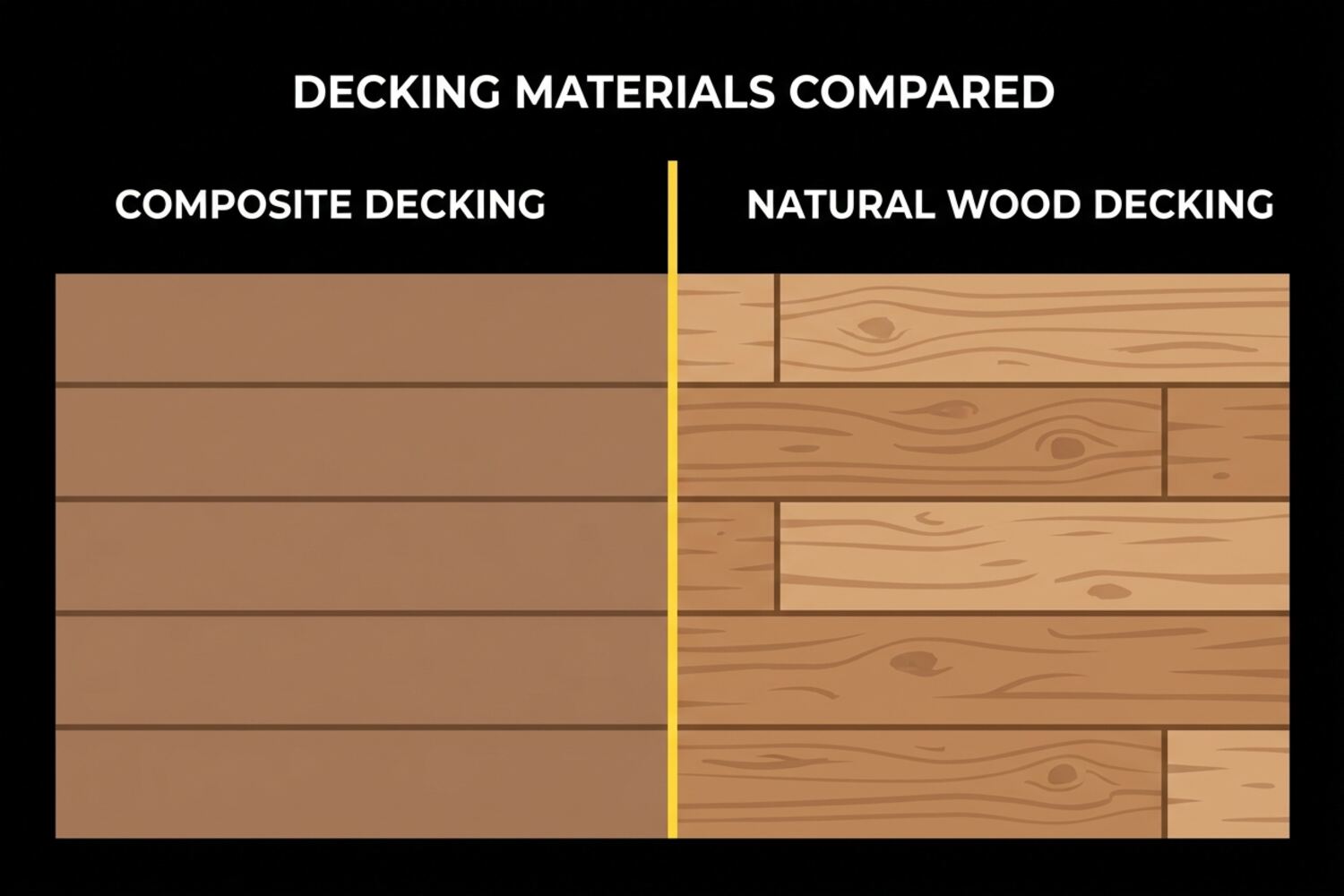
Building a new deck is one of the smartest investments you can make as a Mid-Missouri homeowner. A well-built deck adds usable living space, increases your home’s value, and gives you a place to enjoy everything from weekend cookouts to quiet evenings outdoors. But the first big decision — composite deck vs wood — can feel overwhelming.
At
CoMo Premium Exteriors, we’ve built hundreds of composite and wood
decks across Columbia, Jefferson City, and the surrounding region. We’ve watched how each material holds up through our humid summers, wet springs, and freezing winters. This comparison comes from real jobsite experience — not manufacturer brochures.
## What Is Composite Decking?
Composite decking boards are made from a blend of wood fibers, recycled plastics, and binding agents. The result is a board that mimics the look of wood but resists rot, insects, and moisture far better than natural lumber.
Major composite brands available through Mid-Missouri suppliers include:
– **TimberTech / AZEK** — Our top recommendation. Capped polymer boards with excellent fade and stain resistance.
– **Trex** — The most widely recognized brand. Solid mid-range option with strong color selection.
– **Fiberon** — Good budget-friendly composite with competitive warranties.
Modern composite boards have come a long way from the early versions that looked plasticky and faded fast. Today’s premium composites closely replicate natural wood grain, and many carry 25-to-50-year warranties.
## What Is Wood Decking?
Wood decking uses natural lumber — either softwoods like cedar and pressure-treated pine or hardwoods like ipe and mahogany. For Mid-Missouri projects, the most common options are:
– **Pressure-treated pine** — The most affordable option. Treated with preservatives to resist rot and insects. Available at every lumber yard in Columbia.
– **Cedar** — Naturally rot-resistant with a warm, reddish tone. More expensive than PT pine but requires no chemical treatment.
– **Ipe (Brazilian hardwood)** — Extremely durable and beautiful, but expensive and hard to work with. Requires pre-drilling for every fastener.
Wood delivers an authentic look and feel that some homeowners prefer. But it demands consistent maintenance to perform well in our climate.
## Durability: How Each Material Handles Mid-Missouri Weather
This is where the comparison matters most for local homeowners. Mid-Missouri’s climate is tough on outdoor materials. According to the
National Weather Service St. Louis office, our region sees temperature swings from single digits in winter to the upper 90s in summer, with roughly 42 inches of average annual rainfall.
### Composite Durability
– **Moisture resistance:** Capped composite boards shed water instead of absorbing it. This matters during our spring rainy season, which can deliver weeks of continuous wet weather.
– **Freeze-thaw cycles:** Composite doesn’t absorb water, so it won’t crack from freeze-thaw expansion the way wood can.
– **UV resistance:** Premium composites include UV inhibitors that prevent significant fading. Expect slight color change in the first year, then stability.
– **Insect resistance:** Composite boards are impervious to termites and carpenter ants — both common in our region.
– **Lifespan:** 25–50 years depending on brand and quality.
### Wood Durability
– **Moisture resistance:** Wood absorbs water, leading to swelling, warping, and eventually rot. Pressure treatment helps but doesn’t eliminate the problem.
– **Freeze-thaw cycles:** Absorbed moisture expands when frozen, causing cracking and splitting. This is one of the primary failure modes for wood decks in Mid-Missouri.
– **UV resistance:** Untreated wood grays within a single season. Stain and sealer provide protection but need reapplying every 1–3 years.
– **Insect resistance:** Cedar and pressure-treated wood offer some natural resistance. Untreated softwoods are vulnerable.
– **Lifespan:** 10–20 years for pressure-treated pine, 15–25 years for cedar, 25+ years for ipe — all with proper maintenance.
## Maintenance: The Real Cost Difference
This is often the deciding factor for Columbia-area homeowners.
| Maintenance Task | Composite | Wood |
|—|—|—|
| Annual cleaning | Soap and water wash | Power wash + cleaning solution |
| Staining/sealing | Never needed | Every 1–3 years ($500–$1,500 per application) |
| Board replacement | Rare (warranty coverage) | Common after 8–10 years |
| Sanding | Never needed | Before every restain |
| Annual time investment | 1–2 hours | Full weekend or hire it out |
Over a 20-year span, wood deck maintenance costs can easily exceed the initial price gap between wood and composite. Composite costs more on day one, but often costs less over the life of the deck.
## Cost Comparison for a Typical Mid-Missouri Deck
For a standard 300-square-foot deck (roughly 12×25 feet) — a common size for Columbia homes — here’s what you can expect in 2026:
| Cost Category | Pressure-Treated Wood | Cedar | Composite (mid-range) | Composite (premium) |
|—|—|—|—|—|
| Materials | $1,800–$3,000 | $3,000–$5,000 | $4,500–$7,500 | $7,000–$11,000 |
| Labor (installed) | $3,000–$5,000 | $3,500–$5,500 | $4,000–$6,000 | $4,500–$7,000 |
| Total installed | $4,800–$8,000 | $6,500–$10,500 | $8,500–$13,500 | $11,500–$18,000 |
| 10-year maintenance | $3,000–$6,000 | $2,500–$5,000 | $0–$200 | $0–$200 |
| **10-year total cost** | **$7,800–$14,000** | **$9,000–$15,500** | **$8,500–$13,700** | **$11,500–$18,200** |
Notice how mid-range composite becomes very competitive with pressure-treated wood over 10 years once maintenance is factored in. And composite gives you a better-looking, longer-lasting deck.
## Aesthetic Options: What Each Material Looks Like
### Composite Aesthetics
Modern composite decking comes in dozens of colors — warm browns, rich reds, cool grays, and weathered driftwood tones. Premium lines like TimberTech’s Vintage collection feature multi-tonal color streaking that closely mimics natural hardwood grain.
Composite also offers consistent board-to-board color. No knots, no grain variation between boards, and no color matching headaches during future board replacements.
### Wood Aesthetics
Nothing beats real wood for authenticity. The natural grain variation, the warm feel underfoot, the way it weathers and develops character — these are things composite manufacturers are still working to replicate. Cedar in particular offers a beautiful warm appearance that many Mid-Missouri homeowners love.
The tradeoff is upkeep. Without regular staining, wood turns gray within a season. Some people like the weathered silver look; most don’t. And once wood starts cracking and splintering, the aesthetic advantage disappears quickly.
## Environmental Considerations
Both materials have environmental tradeoffs:
– **Composite:** Most brands use 90%+ recycled materials (recycled plastic bags, sawmill waste). They last longer, reducing replacement waste. However, they aren’t recyclable at end of life and require more energy to manufacture.
– **Wood:** A renewable resource when sustainably harvested (look for
FSC-certified lumber). However, pressure treatment involves chemical preservatives, and the shorter lifespan means more frequent replacement and waste.
For environmentally conscious Columbia homeowners, composite typically wins on lifecycle impact — it lasts longer, requires no chemical maintenance, and uses recycled inputs.
## Building Code Requirements in Columbia, MO
Regardless of material, deck construction in Columbia requires a building permit for most projects. The
City of Columbia Community Development Department requires permits for decks that are:
– More than 30 inches above grade
– Attached to the house
– Over 200 square feet
Both composite and wood decking are accepted under local building codes. The substructure (posts, beams, joists) is almost always pressure-treated lumber regardless of your decking material. Make sure your contractor pulls permits and schedules inspections — it protects your investment.
## Our Recommendation for Mid-Missouri Homeowners
After years of building and servicing decks across the Columbia metro area, here’s our honest take:
– **Choose composite if:** You want a low-maintenance deck that looks great for decades. You don’t want to spend weekends staining and sealing. You plan to stay in your home long-term and want the best return on investment.
– **Choose wood if:** You’re on a tight budget and need the lowest upfront cost. You genuinely enjoy deck maintenance. You want the authentic look and feel of real wood and are committed to maintaining it.
We recommend
TimberTech composite decking for most Mid-Missouri projects. The combination of durability, appearance, and warranty protection makes it the best long-term value for our climate.
If you’re planning a deck project, our
deck builders in Columbia, MO can walk you through material options and provide a free estimate tailored to your property.
Ready to start planning? Call CoMo Premium Exteriors at
(573) 424-9008 for a free consultation. We serve Columbia, Jefferson City, Ashland, Fulton, Boonville, and the surrounding Mid-Missouri region.
## Frequently Asked Questions
### Is composite decking worth the extra cost?
For most Mid-Missouri homeowners, yes. Composite costs 40–60% more upfront than pressure-treated wood, but eliminating staining, sealing, and board replacement costs makes it competitive or cheaper over 10–15 years. With a lifespan of 25–50 years versus 10–20 for wood, composite typically delivers better lifetime value.
### Does composite decking get too hot in summer?
Composite can get warmer than wood in direct sunlight. During peak Missouri summer heat, dark-colored composite boards may become uncomfortable barefoot. Choose lighter colors if your deck gets full afternoon sun, or plan for shade structures. Premium capped composites tend to stay cooler than uncapped versions.
### Can I build a composite deck myself?
Composite decking is actually easier for DIY installation than wood in many ways — uniform boards, no warping, and hidden fastener systems create a clean look. However, the substructure still requires solid carpentry skills, and mistakes with composite materials are expensive. Most Columbia homeowners find professional installation pays for itself in warranty protection.
### How long does a composite deck last in Missouri?
Premium composite from brands like TimberTech and Trex typically lasts 25–50 years in Mid-Missouri’s climate. The key factors are proper installation (especially adequate ventilation underneath) and occasional cleaning. Our moisture and freeze-thaw cycles are tougher on wood than composite, giving composite a real durability edge.
### What is the best wood for decks in Mid-Missouri?
If you choose wood, pressure-treated southern yellow pine offers the best value for our region. It resists rot and insects and is readily available locally. Cedar is a step up in appearance and natural rot resistance but costs more. Avoid untreated softwoods — they’ll fail within a few years in our humid climate.
### Do I need a permit to build a deck in Columbia, MO?
Most deck projects in Columbia require a building permit from the Community Development Department. This applies to decks attached to the house, over 200 square feet, or more than 30 inches above grade. Your contractor should handle the permitting process. Unpermitted decks can cause problems when you sell.
### Does a deck increase home value in Columbia?
Yes. A deck addition typically recoups 60–75% of its cost at resale. In the Columbia housing market, outdoor living space is a strong selling point. Composite decks tend to show better at resale because they look newer longer, while aged wood decks can actually hurt curb appeal if neglected.

Elias Abadi
Founder, CoMo Premium Exteriors
Elias founded CoMo Premium Exteriors with a simple belief: every customer should be treated like family. A Columbia resident since age 10, he has grown the company into one of Mid-Missouri's largest exterior renovation companies through dedication to quality work and standing behind his promises.
Learn more about Elias →